
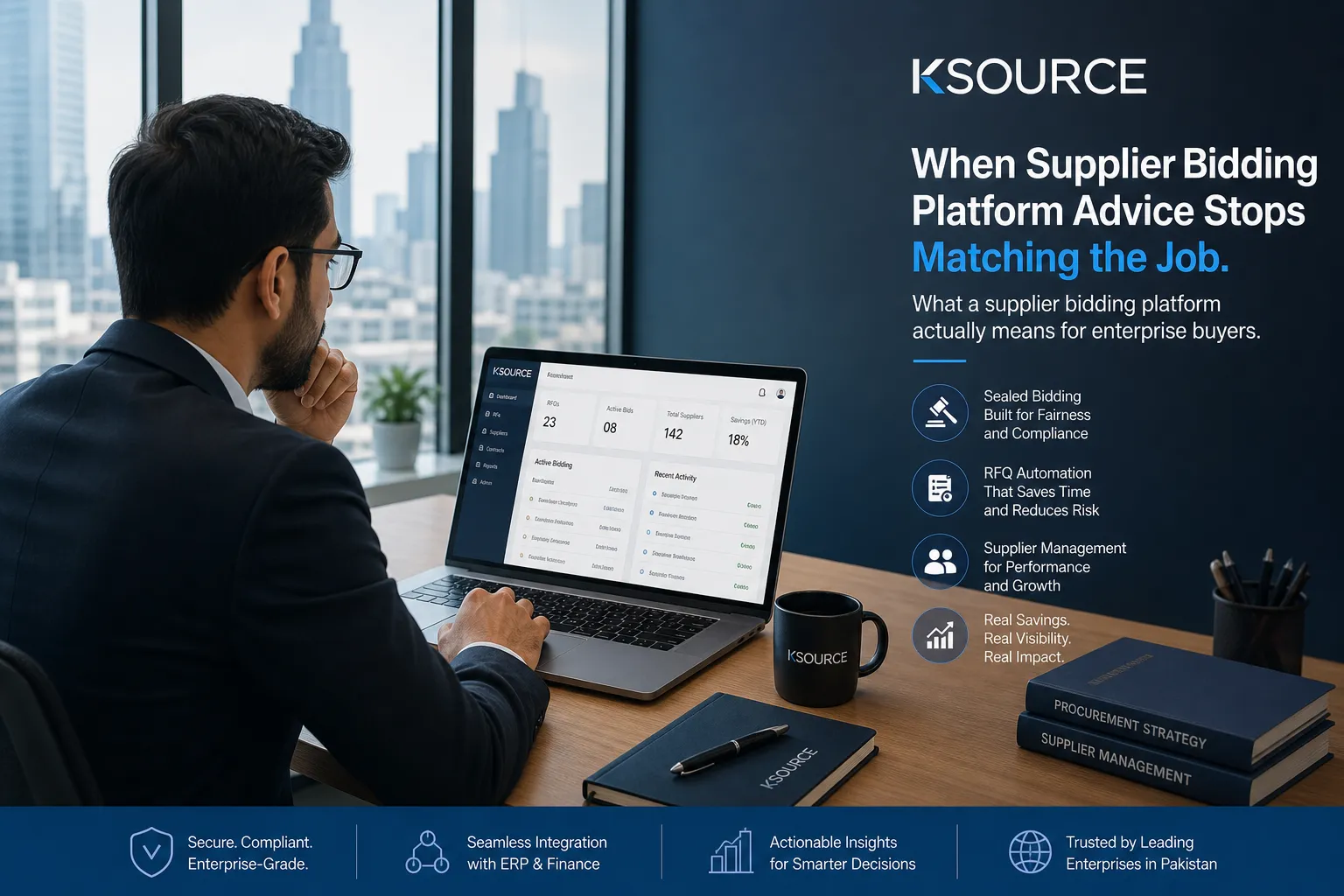
What a supplier bidding platform really has to carry
A supplier bidding platform is not just a place where vendors upload prices. For an enterprise buyer, it should help run RFQs, invite and manage qualified suppliers, receive sealed bids, keep an auditable trail of decisions, and move the approved outcome toward purchase order workflows. When advice about bidding platforms focuses only on “finding more bids” or “posting opportunities,” it stops matching the job of a Procurement Director who has to defend sourcing decisions to finance, operations, compliance, and suppliers.
In Pakistan, that distinction matters because medium and large organisations often buy across multiple sites, categories, approval layers, and vendor types. A sourcing event for packaging, logistics, civil works, IT services, or MRO supplies may look simple at the line-item level, but the procurement team still needs a controlled process: who was invited, what was changed, when bids were received, whether bids stayed sealed until opening, and how the final recommendation was made.
For suppliers, the same platform should make participation clearer. They need to know what is being requested, submit against the buyer’s required structure, avoid missed clarifications or deadlines, and understand that a sealed process protects the integrity of their offer until the correct stage. KSOURCE’s vendor-facing context is relevant here because supplier adoption is not a side issue; buyers only get better sourcing outcomes when credible vendors can actually participate without unnecessary friction. See For Vendors & Suppliers for the supplier-side entry point.
Why “Top 10 eSourcing Platforms for 2026” lists do not settle the decision
A public-sector bid discovery network, a construction tender marketplace, a global source-to-pay suite, and an enterprise RFQ automation platform can all appear under “supplier bidding platform,” while solving different problems.
Some bid networks emphasise connecting businesses with local government opportunities, as seen in public-sector oriented pages such as DemandStar and PlanetBids VendorLine. That can be valuable for suppliers looking for public bids. But a Procurement Director inside a private enterprise usually has a different operating question: can the platform support our own sourcing policy, approval route, supplier records, bid controls, and internal decision trail?
That is where generic “top 10” advice can become misleading.
Use lists to identify categories of software, not to make the decision.
- Bid discovery networks: good for finding external opportunities, especially where buyers publish tenders publicly.
- Supplier marketplaces: useful where vendor discovery and participation need to expand within a managed environment.
- E-procurement platforms: better suited when sourcing, approvals, vendors, and purchase workflows need to sit in one controlled process.
- Full source-to-pay suites: relevant for organisations needing broader procurement coverage, often with more implementation complexity.
KSOURCE sits in the enterprise e-procurement and RFQ management space, so the evaluation should be framed around whether the platform fits your sourcing workflows, vendor participation model, and governance requirements. The KSOURCE Platform page is the right place to check how the product is presented before comparing it against broader suite or marketplace alternatives.
How to select and review e-sourcing software without being distracted by demos
A polished demo can make every supplier bidding platform look organised. The better test is whether it can survive one of your real sourcing events from start to finish. Pick a recent RFQ that caused delays, repeated clarification emails, pricing confusion, supplier complaints, or approval back-and-forth. Then walk through how the software would handle that event.
Start with the event setup. Can procurement define the RFQ structure clearly enough for vendors to submit comparable responses? Can supporting documents, bid conditions, quantities, technical specifications, and timelines be controlled in one place? If the RFQ is for a plant maintenance contract rather than a commodity purchase, can the workflow reflect technical review before commercial opening?
Next, test supplier control. A supplier bidding platform should support a clean distinction between invited, registered, verified, active, and disqualified suppliers. If every vendor record is treated as equal, procurement will still need offline checks to decide who is eligible. KSOURCE has a related guide on the supplier onboarding process, which is worth reading when vendor verification and approval are part of the problem.
Then test bid integrity. In sealed bidding, the platform should prevent premature visibility of commercial offers and support a clear opening stage. The point is not just confidentiality; it is defensibility. If a losing supplier questions the result, procurement should be able to show the process followed the announced rules.
Finally, test what happens after evaluation. A weak platform ends at “download spreadsheet.” A stronger e-procurement workflow supports evaluation, approvals, award recommendation, and onward purchase order activity. If finance is involved late, or if approvals move to WhatsApp and email, the digital process has not really solved the enterprise problem.
A practical e-sourcing scorecard for enterprise buyers
Instead of scoring platforms only by feature count, score them by how well they reduce risk and effort in your actual procurement process. A long feature list is less useful than a small number of capabilities that hold up under audit, supplier pressure, and internal urgency.
1. RFQ creation and control
Check whether buyers can create structured RFQs, attach specifications, set deadlines, issue clarifications, and keep vendors aligned to the same version of requirements. Poor RFQ control produces non-comparable bids, which then pushes evaluation back into manual reconciliation.
2. Sealed bidding discipline
If sealed bidding is required, ask exactly when bids become visible, who can open them, and what record is created. “Private submission” is not always the same thing as a controlled sealed-bid process.
3. Supplier onboarding and eligibility
Supplier management should help procurement distinguish between interested vendors and eligible vendors. This matters when a buyer needs category fit, documentation, approval status, or compliance checks before allowing participation.
4. Workflow flexibility
No-code workflows are valuable when procurement teams need to configure approvals without waiting for a development project. A manufacturing buyer, a services buyer, and a finance reviewer may not need the same route. Workflow flexibility should reduce exceptions, not create hidden workarounds.
5. Evaluation clarity
The platform should help compare vendor submissions in a way that supports a decision. For some categories, lowest price is not enough; technical acceptance, delivery ability, payment terms, warranty, and service coverage may influence award decisions.
6. Data handling and access control
Enterprise procurement data includes supplier documents, prices, commercial terms, and user activity. Buyers should review privacy and access practices carefully, including the platform’s published Privacy Policy, before moving sensitive sourcing activity into any system.
7. Buyer and vendor usability
If suppliers struggle to register, find the RFQ, submit correctly, or respond before the deadline, the buyer pays the cost through weak competition and support calls. A bidding platform must work for both sides of the transaction.
Which e-sourcing software is best for your use case?
The best choice depends on the job you are trying to fix. If suppliers are missing opportunities because they do not know where to find them, a bid discovery network may help. If your procurement team already has suppliers but spends too much time collecting quotations by email, RFQ automation will be more relevant. If the larger issue is policy control, approvals, sealed bidding, vendor records, and purchase order handover, an enterprise e-procurement platform is the stronger fit.
Consider a buyer sourcing generators for multiple sites. If procurement collects bids through email, one supplier may quote with taxes separated, another may bundle delivery, and another may add service terms in a PDF attachment. A supplier bidding platform should force enough structure that commercial and technical differences are visible before the award discussion starts.
Now consider a supplier responding to several corporate RFQs in a month. If every buyer has a different informal process, the supplier has to track deadlines, clarifications, attachments, and submission formats manually. A structured vendor portal can reduce that confusion, but only if the buyer has set up the sourcing event properly.
For Procurement Directors and CFOs, the selection question should be framed like this: where does value leak today? If value leaks at supplier discovery, solve discovery. If value leaks in quotation comparison, solve RFQ structure. If value leaks in approvals and audit trail, solve workflow and governance. If all of these are connected, look at an e-procurement platform rather than a narrow bidding tool. KSOURCE’s For Enterprise Buyers page is the most relevant buyer-side route for that evaluation.
What an e-sourcing platform does beyond collecting bids
An e-sourcing platform helps an organisation run sourcing events digitally: RFIs, RFQs, tenders, bid submissions, supplier communication, evaluation, and award steps. A supplier bidding platform is usually one part of that broader e-sourcing environment. The difference is important because enterprise teams rarely need only a submission box; they need a controlled process that starts before the bid and continues after supplier selection.
For a small purchase, manual quotation collection may be tolerable. For recurring enterprise categories, manual sourcing creates avoidable problems: inconsistent vendor lists, unclear bid deadlines, missing attachments, late clarifications, spreadsheet errors, and undocumented approval logic. E-sourcing is meant to reduce those problems by giving procurement a repeatable process.
KSOURCE’s own content on RFQ process automation and RFQ management systems expands on this practical distinction. The useful takeaway is simple: the platform should not only help you receive bids; it should help you run the sourcing event in a way that a finance head, category owner, supplier, or auditor can understand later.
Mistakes that make bidding platforms underperform
The most common mistake is buying software before cleaning up the sourcing process. A platform cannot make vague specifications precise. If the RFQ asks for “best quality material” without measurable requirements, vendors will submit different interpretations and the evaluation will still be subjective.
A second mistake is treating suppliers as an afterthought. Procurement teams sometimes configure buyer approvals carefully but give less attention to vendor onboarding, communication, and submission instructions. The result is predictable: fewer qualified bids, more clarification messages, and avoidable supplier frustration.
A third mistake is assuming sealed bidding alone creates fairness. Sealed submission helps protect bid confidentiality, but fairness also depends on consistent qualification rules, equal access to clarifications, controlled deadlines, and a documented evaluation method. If these are handled outside the platform, the process can still be challenged.
A fourth mistake is ignoring change management inside procurement. If buyers continue to negotiate offline, open spreadsheets outside the system, or seek approvals on email, the organisation loses the audit trail it expected from digital procurement. The correction is not more software; it is a clear rule for which sourcing steps must happen inside the platform and who is accountable for exceptions.
Is a supplier bidding platform only for public tenders?
No. Public tenders are one visible use case, but private enterprises also use bidding platforms to manage RFQs, supplier participation, sealed commercial submissions, evaluations, and approvals. The right model depends on whether the buyer needs public opportunity discovery, private supplier invitations, or a wider e-procurement workflow.
How should a Procurement Director get started?
Start with one real sourcing category rather than a broad software checklist. Map how suppliers are invited, how bids are received, who reviews technical and commercial responses, how approval happens, and where purchase orders begin. That map will show whether you need RFQ automation, supplier onboarding, sealed bidding, approval workflows, or all of them together.
What should suppliers check before participating?
Suppliers should confirm the submission deadline, required documents, bid format, clarification process, and whether the event uses sealed bidding. They should also keep their company profile and category information current so buyers can assess eligibility without unnecessary back-and-forth.
Your next move with KSOURCE
When supplier bidding platform advice stops at generic rankings, it misses the enterprise job: controlled sourcing, qualified supplier participation, sealed bid handling, defensible evaluation, and a path toward procurement execution. The practical move is to test any platform against one of your own RFQs and see where the process becomes clearer, safer, and easier to defend.
If your organisation is evaluating digital procurement in Pakistan, review the KSOURCE Platform, compare it with your current RFQ and supplier management process, and then visit KSOURCE to take the next step.
