
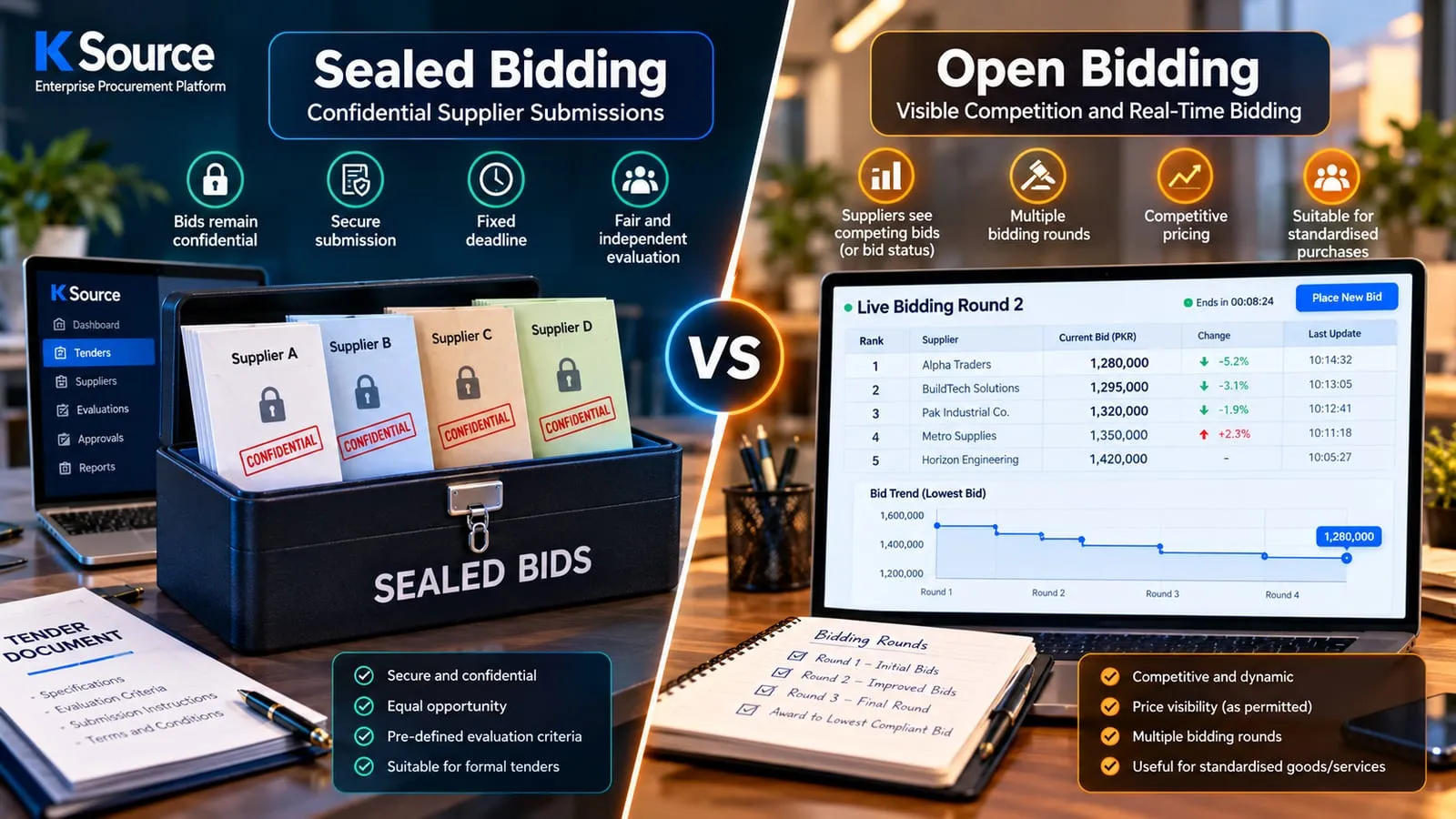
Imagine two suppliers competing for the same industrial equipment contract. Both have received identical specifications, but neither knows the other's quoted price.
They submit their offers before a fixed deadline. The procurement team evaluates the proposals only after the submission period closes.
That is the basic idea behind sealed bidding.
Now consider a different process in which participating suppliers can see competing prices or participate in successive bidding rounds.
The competitive dynamics change significantly.
For enterprise procurement teams, choosing between sealed bidding and more transparent or iterative bidding methods is not simply a software configuration decision. It affects supplier behaviour, information confidentiality, competition and the integrity of purchasing decisions.
This guide explains how different bidding approaches work, their advantages and limitations, and the controls organisations should consider before selecting a method.
What Is Sealed Bidding in Procurement?
Sealed bidding is a procurement method in which suppliers submit offers that remain confidential until an authorised opening or evaluation stage.
In traditional processes, sealed envelopes may be used. In electronic procurement, a digital platform can manage bid submissions, access permissions and opening procedures.
The defining characteristic is that submitted offers are protected from unauthorised disclosure before the designated opening stage.
Depending on the procurement procedure, suppliers may be prohibited from viewing competing offers, and evaluators may have restricted access until the submission deadline.
Sealed bidding is commonly associated with formal tendering and structured competitive procurement.
However, the precise rules vary according to the organisation, purchasing category and applicable procurement framework.
What Does Open Bidding Mean?
The term "open bidding" can describe different procurement arrangements, so it is important to define it before making comparisons.
In some contexts, open bidding refers to a process where suppliers can observe competing offers or participate in successive bidding rounds.
In other contexts, particularly public procurement, an open tender means that eligible suppliers can participate in a publicly advertised opportunity.
These are different concepts.
An open tender may still require confidential sealed submissions.
For this article, the main comparison is between:
- Sealed bidding: Competing offers remain confidential until the designated opening stage.
- Visible-price or iterative bidding: Suppliers may receive permitted information about competing prices or participate in additional bidding rounds.
This distinction helps procurement teams avoid selecting a bidding method based on ambiguous terminology.
Sealed Bidding vs Open Bidding: Key Differences
| Evaluation factor | Sealed bidding | Visible-price or iterative bidding |
|---|---|---|
| Bid confidentiality | Offers remain confidential before authorised opening | Selected competitive information may be visible |
| Supplier price visibility | Competing prices are normally hidden | May include permitted price or ranking visibility |
| Submission structure | Often uses a defined submission deadline | May involve multiple rounds |
| Price revision | Depends on tender rules and permitted clarifications | May allow competitive revisions |
| Primary control concern | Confidentiality and authorised bid opening | Fair information access and bidding rules |
| Suitable applications | Formal tenders and confidential quotations | Selected competitive sourcing or auction scenarios |
Neither approach is automatically superior.
The appropriate choice depends on the purchasing objective, market conditions, technical complexity and applicable rules.
How a Sealed Bidding Process Works
A structured sealed bidding process normally includes several stages.
1. Define the procurement requirement
The buyer establishes the required goods or services, technical specifications, delivery expectations and commercial conditions.
Evaluation criteria and submission requirements should be defined before suppliers prepare their bids.
2. Invite eligible suppliers
Depending on the procurement method, the opportunity may be publicly advertised or restricted to eligible suppliers.
The buyer communicates the deadline, submission instructions and applicable conditions.
3. Receive confidential bids
Suppliers submit their proposals through the designated channel.
Access controls should prevent unauthorised parties from viewing confidential bid contents before the permitted stage.
4. Close submissions
At the specified deadline, the system or procurement administrator closes the submission period according to the tender rules.
Late submissions should be handled consistently with those rules.
5. Open bids through authorised procedures
Approved personnel access the submitted offers at the designated stage.
The process should preserve an appropriate record of bid receipt and opening activities.
6. Evaluate proposals
Technical and commercial evaluation follows the methodology established for the procurement.
Depending on the tender, this may involve mandatory compliance checks, weighted technical scoring and commercial comparisons.
7. Record and approve the decision
The procurement team documents the evaluation outcome and obtains the necessary approvals before awarding the contract.
Maintaining a clear record of the process helps support accountability and future review.
Why Bid Confidentiality Matters
Confidentiality helps protect sensitive commercial information during a competitive procurement process.
Supplier quotations may contain pricing strategies, technical proposals, delivery arrangements and commercially sensitive terms.
Premature disclosure can affect the fairness of competition.
For example, if one supplier obtains another supplier's confidential price before the submission deadline, it may gain an unfair opportunity to adjust its own offer.
Confidentiality controls should therefore address more than hiding a price column on a screen.
Depending on the system and process, relevant safeguards may include:
- Role-based access permissions
- Submission deadlines
- Restricted bid opening
- Recorded submission timestamps
- Appropriate encryption controls
- Audit records of relevant actions
- Controlled handling of bid amendments
The presence of these controls should be verified in the procurement platform being evaluated.
A software provider's use of the term "sealed bidding" does not, by itself, establish the exact technical or security implementation.
When Sealed Bidding May Be Appropriate
Sealed bidding can be suitable when procurement teams need independent supplier offers submitted under consistent conditions.
Potential applications include:
- Industrial equipment procurement
- Formal competitive tenders
- High-value purchasing events
- Procurement involving sensitive commercial quotations
- Purchases requiring documented bid-opening procedures
However, suitability depends on the organisation's procurement policy and the relevant market.
Sealed bidding may be less flexible where requirements are still evolving or where extensive supplier dialogue is necessary before final offers can be prepared.
In those circumstances, a different sourcing procedure may be more appropriate.
When Iterative or Visible-Price Bidding May Be Useful
Some procurement categories benefit from a competitive process in which suppliers can revise prices under predefined rules.
For example, a buyer sourcing standardised goods may be able to compare offers more directly when technical specifications and delivery conditions are already established.
An electronic reverse auction is one example of an iterative bidding mechanism.
In a reverse auction, qualified suppliers may compete by submitting progressively improved commercial offers.
However, the method requires careful preparation.
Before using it, procurement teams should consider:
- Whether the purchasing specification is sufficiently clear
- Whether suppliers are genuinely comparable
- Whether quality requirements have been addressed
- Whether competition is adequate
- Whether the bidding rules are understood
- Whether the process is permitted under applicable procurement policies
Visible-price competition should not be treated as a substitute for technical qualification.
A low bid does not necessarily represent the best overall purchasing outcome.
Sealed Bidding and Procurement Transparency Are Not Opposites
A common misunderstanding is that confidential bids make a procurement process less transparent.
In reality, confidentiality and transparency address different concerns.
Confidentiality protects information that should not be disclosed during competition.
Transparency supports clear rules, consistent evaluation and accountability.
A procurement process can protect supplier quotations before opening while still maintaining comprehensive records of how the award decision was reached.
For example, an organisation may keep competing prices confidential during submission but document:
- The published evaluation criteria
- Supplier eligibility requirements
- Submission deadlines
- Bid receipt records
- Authorised opening activities
- Evaluation results
- Approval decisions
The objective is to provide appropriate visibility to authorised stakeholders without compromising commercially sensitive information.
Pakistan-Specific Procurement Considerations
Businesses operating in Pakistan should distinguish between private-sector purchasing policies and public procurement requirements.
Private enterprises generally establish procurement procedures according to their governance requirements, contracts and applicable laws.
Public procurement may be subject to specific rules established by the relevant procurement authority.
At the federal level, the Public Procurement Regulatory Authority provides procurement rules and guidance.
Provincial procurement frameworks may also apply to relevant public-sector organisations.
Procurement teams should confirm which framework governs a particular transaction before selecting a tendering procedure.
The terms "open competitive bidding," "sealed bidding" and "single-stage" or "two-stage" procedures may have specific meanings within applicable public procurement rules.
Those legal meanings should not be replaced with informal software terminology.
Official federal procurement information is available from the Public Procurement Regulatory Authority.
Common Mistakes When Selecting a Bidding Method
Confusing open tendering with visible-price bidding
Publicly inviting suppliers does not necessarily mean competing quotations should be visible before the authorised opening stage.
Changing bidding rules after submissions begin
Unannounced changes can undermine consistency and create disputes.
Ignoring technical suitability
Price competition cannot compensate for a supplier's failure to satisfy essential technical requirements.
Allowing inappropriate access to confidential offers
Weak access controls can expose sensitive commercial information.
Failing to document bid amendments
Where amendments are permitted, the process should establish how they are submitted, recorded and evaluated.
Assuming digital bidding automatically prevents misconduct
Technology can support controls, but appropriate governance, permissions, monitoring and human oversight remain necessary.
What to Look for in Sealed Bid Software
When evaluating electronic sealed bidding software, procurement teams should examine how the platform supports the complete sourcing process.
Important questions include:
- How are confidential bids protected before opening?
- Who can access submissions and at which stage?
- Can submission deadlines be enforced?
- How are late or amended bids handled?
- Are bid-opening activities recorded?
- Can technical and commercial evaluations be separated?
- How are evaluation decisions approved?
- Can the organisation retrieve relevant audit records?
- What happens if a user or administrator attempts unauthorised access?
- How are system failures near submission deadlines handled?
These questions are useful because sealed bidding is both a procurement procedure and a technical control requirement.
Organisations should request demonstrations of relevant workflows rather than relying exclusively on feature descriptions.
How KSource Supports Enterprise Bidding Workflows
KSource describes sealed bidding as part of its enterprise e-procurement capabilities.
Its published platform information also identifies RFQ management, technical evaluation committees, comparative statements and approval workflows.
These capabilities are relevant to organisations seeking to coordinate supplier competition and purchasing decisions within a digital procurement environment.
Businesses can explore the KSource enterprise buyer platform to understand its sourcing and evaluation capabilities.
For a broader overview, see the KSource procurement platform.
Specific security controls, bid-opening permissions, audit functionality and configuration options should be confirmed directly with KSource during a product evaluation.
Frequently Asked Questions
What is the main advantage of sealed bidding?
Sealed bidding protects competing offers from unauthorised disclosure before the designated opening stage, helping preserve independent submissions under the established tender rules.
Can an open tender use sealed bids?
Yes. Open tendering generally concerns supplier participation, while sealed bidding concerns how offers are submitted and protected. An openly advertised tender may require confidential sealed submissions.
Is sealed bidding always better than open bidding?
No. The appropriate method depends on procurement objectives, technical complexity, supplier competition, applicable rules and the level of confidentiality required.
What is electronic sealed bidding?
Electronic sealed bidding uses a digital system to receive and manage confidential supplier offers according to defined submission and opening procedures.
Does sealed bidding guarantee fair procurement?
No. Confidentiality is one important control, but fair procurement also requires clear requirements, consistent evaluation criteria, appropriate access permissions and accountable decision-making.
Is sealed bidding suitable for private companies in Pakistan?
It may be suitable for private-sector sourcing where confidential competitive quotations are appropriate. The organisation should establish clear procedures and ensure the process complies with applicable contractual and legal requirements.
Choosing a Bidding Method That Fits the Purchase
The decision between sealed bidding and other competitive bidding methods should begin with the purchasing requirement rather than the technology.
Procurement teams need to consider supplier competition, technical complexity, confidentiality, evaluation procedures and the organisation's governance requirements.
Sealed bidding can support confidential supplier submissions, while iterative bidding methods may offer flexibility for selected purchasing categories.
Neither approach removes the need for clear rules and documented decisions.
For enterprises exploring digital sourcing workflows, KSource provides procurement capabilities covering RFQs, sealed bidding, evaluations and purchasing approvals.
Review the platform's buyer capabilities and request a demonstration to assess how its bidding workflows fit your organisation's requirements.
