
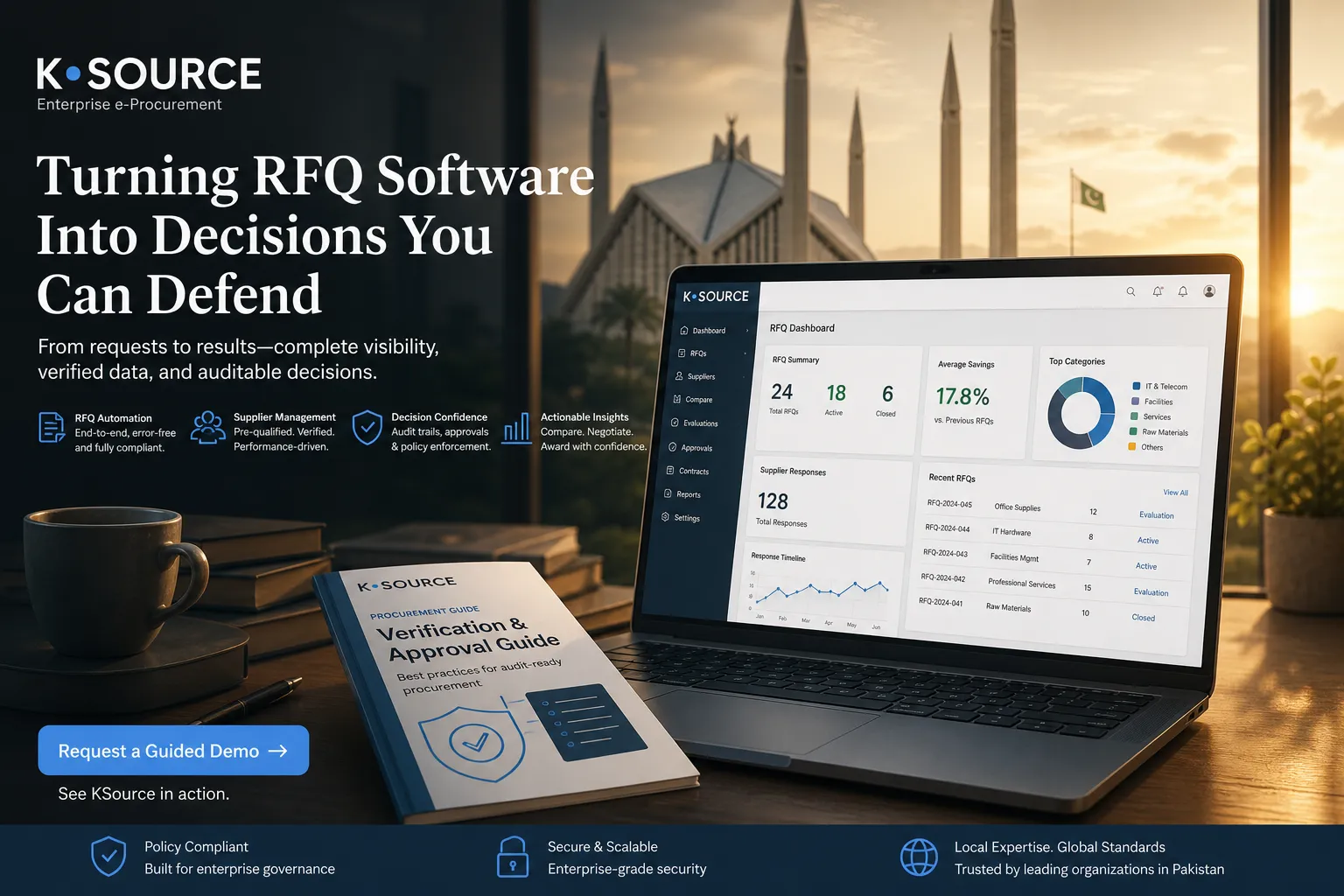
What RFQ software has to prove in enterprise procurement
RFQ software should do more than collect prices. For a procurement director, CFO, or supply chain head in Pakistan, it should help the organisation issue a clear request, invite the right suppliers, protect bid confidentiality where needed, compare offers consistently, route approvals, and retain a decision trail that can be explained later to finance, audit, management, and suppliers.
The problem is that much RFQ advice still treats procurement as a simple form: create a request, receive quotes, pick the lowest price. That may work for low-value, repeat purchases. It does not match enterprise buying, where a quotation may depend on tax treatment, delivery location, warranty terms, technical compliance, payment schedule, after-sales support, and the supplier’s ability to actually deliver in Karachi, Lahore, Islamabad, or across multiple sites.
In practice, RFQ software sits inside a larger e-procurement and e-sourcing process. It should connect the request, supplier list, bidding method, clarification process, evaluation criteria, approval matrix, and final award. KSOURCE is positioned around this full procurement cycle: enterprise buyers, vendors, workflows, sealed bidding, and supplier participation are part of the same operating picture rather than separate spreadsheets and email threads.
The difference between collecting quotes and making a defensible decision
A defensible RFQ decision is not just a final selected vendor name. It is the reasoning behind that selection. If two suppliers quote different prices, the buyer needs to know whether they quoted against the same specification, accepted the same delivery timeline, included the same taxes, and met the same compliance requirements. Without that structure, the procurement team can end up defending a decision that was never properly comparable.
Good RFQ software therefore needs to control the inputs before it calculates or compares anything. At a minimum, procurement teams should define:
- the item, service, or scope being quoted, with enough detail to prevent vague responses;
- mandatory commercial terms such as delivery date, payment terms, taxes, and warranty expectations;
- technical or service requirements that make a quote compliant or non-compliant;
- the bidding method, especially whether prices should remain sealed until the correct stage;
- who may approve the RFQ, evaluate responses, negotiate, and award;
- how supplier questions and clarifications will be handled.
This is where RFQ automation becomes useful. Automation is not merely sending reminders. It reduces the hidden variation that enters a sourcing event when different departments use different formats, different supplier lists, and different approval habits. KSOURCE’s procurement workflow context, including no-code workflows and sealed bidding, is relevant because enterprise procurement often needs control without making every sourcing event dependent on IT changes.
For bidding design, the distinction between sealed and open bidding matters. If the requirement is transparency in bid opening and confidentiality before the deadline, sealed bidding is usually the more controlled approach. If the business wants visible competitive movement, open bidding may be appropriate in some contexts. KSOURCE’s Sealed Bidding vs Open Bidding guide explains that difference in more detail for procurement teams deciding how to structure competition.
Supplier onboarding belongs before the RFQ, not after it
One common mistake is to start the RFQ first and verify the supplier later. That creates avoidable pressure. If the lowest quote comes from a supplier whose business identity, tax standing, delivery capability, or approval status is unclear, the buyer is forced into a difficult position: delay the award, reopen the RFQ, or push through a risky exception.
Supplier onboarding is the process of registering, verifying, approving, and maintaining supplier information before that supplier participates meaningfully in procurement activity. In enterprise RFQ software, onboarding should not be treated as an admin side task. It is the front gate of sourcing quality.
For example, say a manufacturing business issues an RFQ for packaging material to multiple vendors. One vendor offers the lowest rate per unit, but later it becomes clear that the supplier cannot support the required monthly volume or has incomplete business documentation.
A practical supplier onboarding process should confirm whether the supplier is eligible for the category, capable of delivering the requested scope, and approved according to the organisation’s internal rules. For a deeper process view, KSOURCE’s Supplier Onboarding Process guide covers verification and approval as part of procurement readiness.
What supplier verification should cover before quotations are requested
Supplier verification is not about making procurement slow. It is about preventing the RFQ result from being compromised by incomplete supplier data. The checks should match the risk and value of the purchase. A routine office supplies RFQ does not need the same depth as a critical spare parts contract, civil works package, logistics service, or recurring raw material supply.
The first layer is business identity. The buyer should know who the supplier is, what legal or business name they operate under, who is authorised to respond, and whether the account details and contact channels are legitimate. If identity data is weak, even a clean-looking quotation can create payment, tax, or dispute issues later.
The second layer is category fit. A supplier may be valid as a business but unsuitable for a particular RFQ. Enterprise procurement teams should separate general registration from category approval. A vendor approved for office equipment should not automatically be eligible for specialised industrial maintenance or regulated goods without additional review.
The third layer is performance capability. The RFQ should ask for information that proves the supplier can meet the required volume, delivery timeline, location coverage, after-sales obligation, or technical standard. This matters in Pakistan where multi-city delivery, import dependencies, local stock availability, and service response times can materially affect the real cost of a purchase.
The fourth layer is internal approval. Supplier approval should connect to the procurement approval matrix so that exceptions are visible. If a supplier is conditionally approved or pending documentation, the RFQ software should make that status clear before evaluation begins, not after the award recommendation is ready.
How to structure an RFQ so evaluation does not become a debate
The strongest RFQ events are designed backwards from the decision that must be defended. If price is the only factor, the RFQ can be simple. If technical compliance, delivery lead time, warranty, and payment terms matter, those fields must be captured in a structured way.
A useful RFQ structure often includes three separate layers: mandatory requirements, priced commercial response, and evaluation notes. Mandatory requirements decide whether a response is eligible. Commercial fields compare cost. Evaluation notes explain judgement where the decision is not purely mathematical.
Consider a facilities team buying generators for multiple branches. One supplier quotes a lower unit price but excludes installation. Another includes installation, commissioning, and a longer warranty. A spreadsheet may show the first supplier as cheaper, but a structured RFQ can reveal that the offers are not equivalent. The procurement team can then compare total commercial value instead of defending a misleading lowest-price decision.
This is also where a vendor marketplace can become useful if it is governed properly. A marketplace should not simply increase the number of suppliers; it should help buyers reach relevant, verified suppliers and convert supplier participation into usable sourcing decisions. KSOURCE’s article on turning a B2B procurement marketplace into decisions expands on this point from the buyer’s perspective.
RFQ software should therefore help procurement teams standardise the event without flattening every purchase into the same template. The structure for spare parts, professional services, transport, IT equipment, and construction material will not be identical. The software should allow workflow control while still reflecting the actual buying category.
Where sealed bidding, open bidding, and approvals fit into RFQ software
RFQ software becomes much more useful when it supports the right sourcing method rather than forcing every event into one model. Sealed bidding is designed to keep bid contents confidential until the defined opening stage. That can matter when the organisation wants to reduce premature visibility into supplier pricing and create a clearer record of when bids were submitted and opened.
Open bidding has a different logic. It may suit situations where visible competition is intended, but it can also change supplier behaviour. The right choice depends on the category, the organisation’s governance requirements, and whether the buyer wants confidential independent offers or visible competitive movement.
Approvals are the other half of the control model. A clean RFQ can still fail governance if the award bypasses purchasing authority. Procurement teams should connect RFQ stages to approval rules: who approves the RFQ before release, who approves the supplier shortlist, who can see bids, who evaluates, and who signs off the final award. KSOURCE’s procurement approval matrix content is relevant here because authority limits and decision rights are part of whether an RFQ outcome can be defended internally.
The practical test is simple: if an auditor, CFO, or business head asks why a supplier was selected, the system should show the RFQ scope, invited suppliers, bid status, evaluation basis, approval path, and award reasoning. If that explanation still depends on searching inboxes and asking individuals what happened, the software is not yet doing the full job.
Mistakes to avoid when choosing RFQ software
The first mistake is buying for form creation rather than decision control. A digital RFQ form is useful, but it is not enough if supplier onboarding, bid confidentiality, evaluation, and approvals live elsewhere.
The second mistake is treating supplier count as supplier quality. More vendors do not automatically create better competition. Unverified or irrelevant suppliers can create noise, weak responses, and disputes about fairness. A smaller pool of approved, category-fit suppliers may produce a more reliable outcome than a long list of unqualified invitees.
The third mistake is ignoring supplier experience. Vendors need clear RFQ instructions, response fields, deadlines, and clarification channels. If the process is confusing, serious suppliers may respond poorly or avoid participating. That weakens competition before evaluation begins.
The fourth mistake is assuming every RFQ should be lowest-price. For some categories, lowest compliant price is appropriate. For others, total value depends on lead time, service capability, warranty, stock availability, and risk. RFQ software should allow procurement to capture those factors rather than hide them in email comments.
The fifth mistake is separating RFQ activity from enterprise procurement governance. Medium and large organisations usually need purchasing controls across departments, locations, and budget owners. If sourcing decisions are not connected to workflows and approval authority, procurement may digitise the RFQ but leave the real control gap untouched.
What is sealed bidding in procurement?
Sealed bidding is a sourcing method where suppliers submit bids that remain confidential until the defined opening point. In an RFQ context, it helps protect bid visibility before evaluation and supports a cleaner record of supplier submissions. It is especially relevant when confidentiality and controlled bid opening matter.
What does open bidding mean?
Open bidding generally means supplier participation or pricing activity is more visible during the event, depending on how the process is configured. It may encourage competitive movement, but it is not automatically better. Procurement should choose open or sealed bidding based on category risk, governance needs, and the behaviour it wants from suppliers.
How should a procurement director get started?
Start by mapping one real RFQ category from request to award. That map will reveal whether the priority is supplier onboarding, sealed bidding, workflow control, evaluation structure, or all of them together.
Your next move with KSOURCE
The useful question is not “Do we need RFQ software?” Most enterprise procurement teams already know they need a more controlled way to request and compare supplier quotations. The better question is: “Can our RFQ process produce a decision we can defend?”
It needs sourcing structure, supplier verification, bidding control, and workflow discipline in one procurement environment.
KSOURCE brings those concerns into the enterprise e-procurement conversation through RFQ management, sealed bidding, vendor participation, and procurement workflows. To explore how this could apply to your organisation’s sourcing process, visit KSOURCE and review where your current RFQ process is strongest, weakest, and hardest to explain.
