
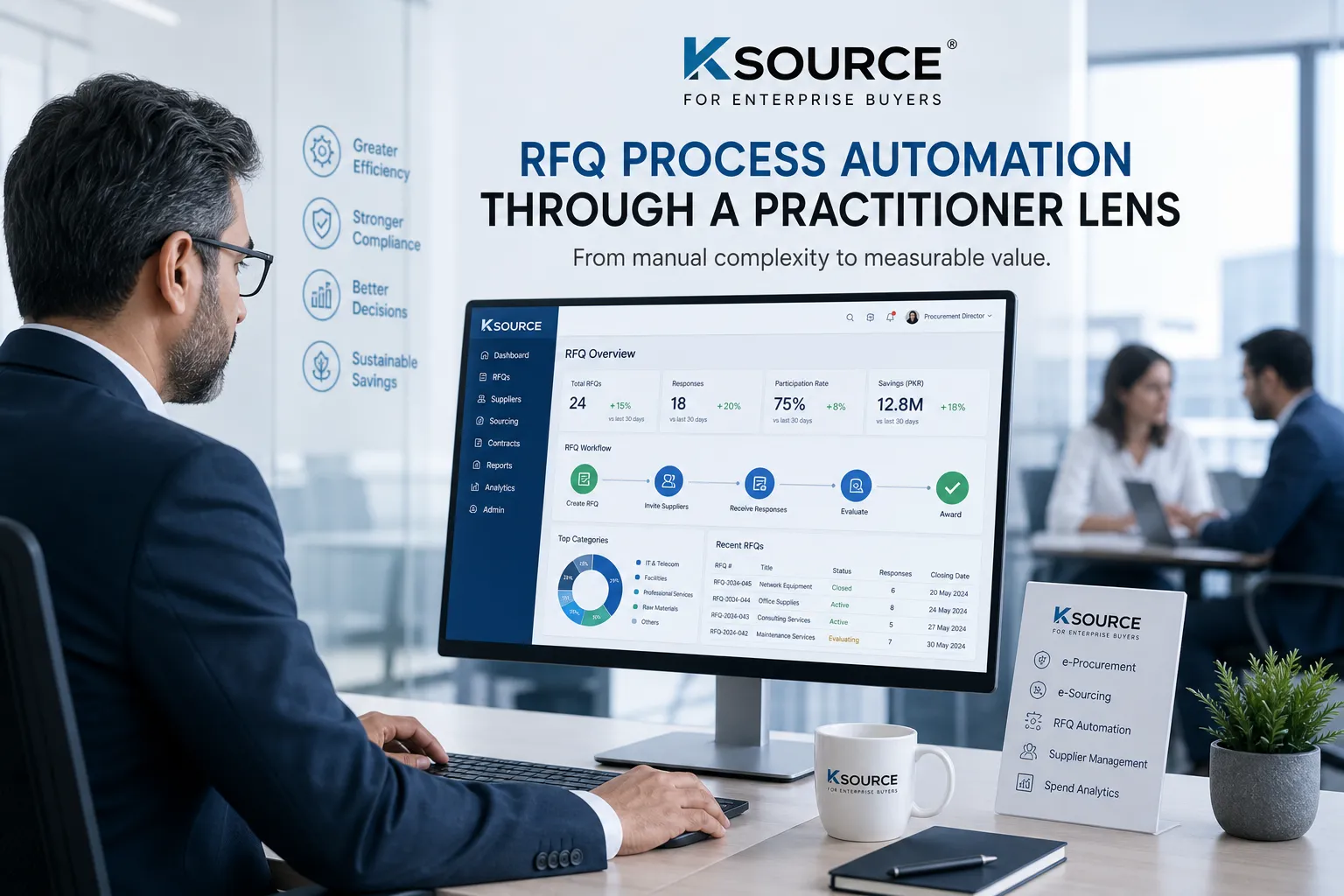
What RFQ process automation actually changes
RFQ process automation means moving the repeatable parts of a request-for-quotation cycle—creating the request, inviting suppliers, receiving sealed quotes, tracking responses, comparing submissions, and moving the selected quote towards purchase order workflows—out of scattered email and spreadsheets and into a controlled digital procurement workflow. For procurement directors in Pakistan, the real point is not “less paperwork” as a slogan; it is better control over price discovery, supplier participation, approval discipline, and auditability when multiple departments and vendors are involved.
That may work for a low-value one-off buy. It becomes fragile when a manufacturer is sourcing plant spares, a hospital is comparing approved medical supplies, or a multi-location enterprise is buying services across cities with finance oversight.
Practically, automation should cover three layers. First, the RFQ document itself: item description, quantities, delivery expectations, commercial terms, tax requirements, attachments, and closing time. Second, supplier interaction: invite the right vendors, keep response windows consistent, and reduce back-channel confusion. Third, decision support: compare quotes on a like-for-like basis while keeping commercial judgement visible. KSOURCE’s buyer-facing e-procurement context is built around this kind of enterprise workflow, connecting buyers and vendors through RFQ management, sealed bidding, no-code workflows, and purchase order workflows. Procurement teams reviewing the wider buyer journey can start with For Enterprise Buyers | KSOURCE.
Where SAP Business One fits—and where RFQ automation needs more structure
Many medium and large organisations use ERP systems such as SAP Business One as the system of record for finance, inventory, vendors, items, and purchasing documents. That matters because RFQ automation should not become a separate island. If vendor master data, item codes, tax treatment, and purchase approvals live in an ERP, the RFQ workflow needs to respect that operational reality.
A sensible approach is to treat SAP Business One as part of the procurement architecture, not as a reason to keep RFQs manual. The exact connection pattern depends on each organisation’s implementation, integrations, and internal controls; it should not be assumed without technical review.
For example, a procurement team buying packaging material may already have approved item masters and vendor records in its ERP. The sourcing pain is not the existence of the item code; it is the repeated work of emailing ten suppliers, chasing six replies, normalising different quotation formats, and proving that the final recommendation was commercially fair. RFQ process automation should remove that avoidable friction while preserving the ERP’s role in finance and stock control.
This is also where sealed bidding matters. In sensitive categories, early visibility of supplier pricing can create governance concerns. A controlled digital workflow can help ensure bids are submitted into the system and opened according to the defined process rather than circulating through informal inboxes.
A practical sequence for automating RFQs
The mistake many organisations make is trying to automate every purchasing variation at once. A better first move is to choose a repeatable RFQ category with enough volume to matter, but not so much complexity that the pilot turns into a full ERP transformation.
- Do not rely only on the formal SOP; the informal workarounds are usually where automation produces the most value.
Standardise the RFQ document. Define mandatory fields: item or service description, quantity, delivery location, expected delivery date, taxes, payment terms, warranty or after-sales requirements, technical attachments, and bid closing time. A vague RFQ creates vague responses, even inside the best software.
Clean supplier lists before invitation. Automation will not fix a vendor database full of duplicates, inactive suppliers, or poorly classified categories. For Pakistani enterprises, this is especially important where suppliers may serve specific cities, provinces, import categories, or after-sales coverage zones.
- In a no-code workflow environment, these rules can be reflected without forcing every request through the same path.
- It should support the buyer; it should not silently replace the buyer’s judgement where quality, risk, or supplier reliability matter.
Move the awarded result into PO workflows. The RFQ cycle is not complete when a supplier is selected. The useful endpoint is a controlled transition into purchase order creation, approval, and downstream procurement records.
If your organisation is still formalising the earlier request stage, KSOURCE also publishes related guidance on purchase requisition software, which is often the upstream control point before an RFQ is issued.
What changes when organisations move from SAP Business One towards cloud ERP models
Some procurement leaders evaluating RFQ automation are also considering a move from SAP Business One towards a cloud ERP model. The RFQ question should be part of that conversation, but it should not be reduced to “old system versus new system”. The practical issue is how procurement data, approvals, supplier interaction, and finance controls will operate when more of the workflow is online, multi-user, and integrated.
Cloud ERP models can make it easier for distributed teams to work from shared data, especially when procurement, finance, and operations are not sitting in one office. For businesses with branches in Karachi, Lahore, Islamabad, Faisalabad, Multan, or industrial zones outside major cities, this can affect day-to-day RFQ handling: who can see an open request, who can approve a quote, and how quickly missing supplier information is resolved.
However, moving to cloud ERP does not automatically solve RFQ discipline. If the RFQ process is poorly defined, a cloud platform may simply make poor habits more visible.
KSOURCE sits in the e-procurement and sourcing layer, so its relevance is in how enterprise buyers and vendors interact around RFQs, sealed bidding, workflows, and purchase order processes. The right architecture may include ERP, procurement workflow, vendor marketplace capabilities, and internal finance approval, but the exact design should follow the organisation’s control requirements.
Scaling RFQs beyond one office or one supplier market
RFQ automation becomes more valuable when buying is no longer local, informal, or limited to a familiar supplier circle. A procurement team sourcing maintenance services for one plant can manually manage a few trusted vendors. A group company sourcing across multiple locations, categories, and business units needs a more consistent way to invite, evaluate, and record supplier participation.
For Pakistani enterprises expanding into new cities or working with regional and international suppliers, the RFQ workflow needs to handle practical differences: delivery areas, tax documentation, lead times, currency considerations where applicable, import-related dependencies, and different service coverage. Automation does not remove these variables, but it can force them into the quotation format so that procurement and finance are not discovering gaps after award.
A useful RFQ template for expansion should include:
delivery location and unloading or installation responsibilities;
quote validity period and expected delivery timeline;
tax, withholding, and invoice documentation requirements;
technical compliance fields where specifications are non-negotiable;
space for supplier exceptions, rather than hiding them in email attachments;
evaluation criteria beyond unit price, especially for critical goods and services.
More importantly, suppliers understand the buying organisation’s expectations earlier. That reduces avoidable clarification loops and helps vendors compete on the actual requirement rather than on who interpreted the email most favourably.
Distribution, response tracking, and quote comparison are the operational core
The visible promise of RFQ process automation is speed, but the deeper benefit is process integrity. Three capabilities matter most in day-to-day use: distributing RFQs to the right suppliers, tracking responses without manual chasing, and comparing quotes in a form that supports a defensible recommendation.
Distribution should be controlled, not merely fast
Sending an RFQ quickly to every supplier in a database is not good sourcing. Procurement teams need category-relevant supplier lists, eligibility checks, and clarity on who was invited. If a category is sensitive, the team also needs confidence that the bid window and sealed submission process are consistent for all participating vendors.
Response tracking should show silence as clearly as submissions
A manual tracker often records only who has replied. A stronger RFQ workflow also shows who has not responded, which suppliers opened or acknowledged the request if that capability is available, and which responses are incomplete. This matters because non-response can reveal supplier fatigue, unclear requirements, unrealistic timelines, or a weak vendor panel.
Quote comparison should expose differences, not hide them
The cheapest line item is not always the best commercial result. One supplier may quote lower but exclude delivery. Another may include installation and warranty. A third may meet the technical specification but require a longer lead time. Automation should help procurement compare price, compliance, delivery, taxes, terms, and exceptions side by side, while leaving room for documented commercial reasoning.
This is where KSOURCE’s RFQ management and sealed bidding context is relevant for enterprise buyers and corporate vendors. The platform’s stated focus on connecting hosts, buyers, and vendors through digital procurement workflows gives procurement teams a practical frame: automate the repeatable mechanics, keep the buying decision transparent, and carry the result into the next procurement step. Teams evaluating data handling should also review the KSOURCE Privacy Policy as part of their internal vendor and platform assessment.
Common mistakes that weaken RFQ automation
RFQ automation fails when it is treated as a software switch rather than a procurement design exercise. The most common error is automating a messy template. If item descriptions are incomplete, quantities are unclear, and evaluation criteria are not defined, suppliers will still submit inconsistent quotes; the inconsistency will simply arrive through a digital channel.
A second mistake is ignoring supplier experience. Vendors participating in enterprise procurement need clear instructions, reasonable timelines, and a predictable submission method. If the process is difficult to understand, capable suppliers may skip the RFQ or submit incomplete responses, reducing competitive tension.
A third mistake is over-automating the award logic. For commodity items with identical specifications, automated ranking may be helpful. For technical, safety-critical, imported, or service-heavy categories, procurement should use automation to organise facts, not to bury judgement. Finance and audit teams usually want to know why a recommendation was made, not only which line showed the lowest number.
Finally, organisations sometimes forget the purchase order handoff. If the selected quote has to be retyped into another system with no control, errors can return at the final stage. The RFQ process should be connected to downstream purchase order workflows wherever the organisation’s systems allow.
What is an RFQ in procurement?
An RFQ, or request for quotation, is a formal request sent to suppliers asking them to quote for defined goods or services. It is most useful when the requirement is clear enough for suppliers to price competitively against the same scope.
Why do organisations use RFQs instead of buying directly?
RFQs help buyers test the market, compare commercial offers, document supplier participation, and support fair purchasing decisions. For enterprise procurement, the record of how the quote was requested, received, compared, and approved can be as important as the final price.
What should an RFQ document include?
A strong RFQ document should include the item or service scope, quantities, delivery location, submission deadline, technical requirements, tax and payment expectations, quote validity, required attachments, and the basis on which responses will be evaluated.
A useful next move with KSOURCE
The practical starting point is to select one RFQ category and map it from request creation to purchase order handoff. Look for the points where time is lost, supplier responses become inconsistent, or approval evidence is weak. Those are the areas where RFQ process automation can create visible control without forcing the whole procurement function to change overnight.
If your organisation is assessing digital sourcing, sealed bidding, vendor participation, or purchase order workflow improvements, review how KSOURCE supports enterprise buyers through its e-procurement platform and buyer workflows. You can learn more about the company on the About | KSOURCE page or speak to the team through Request a Demo | KSOURCE. The best discussion will be concrete: bring one real RFQ category, one current comparison sheet, and one approval path you want to improve.
