
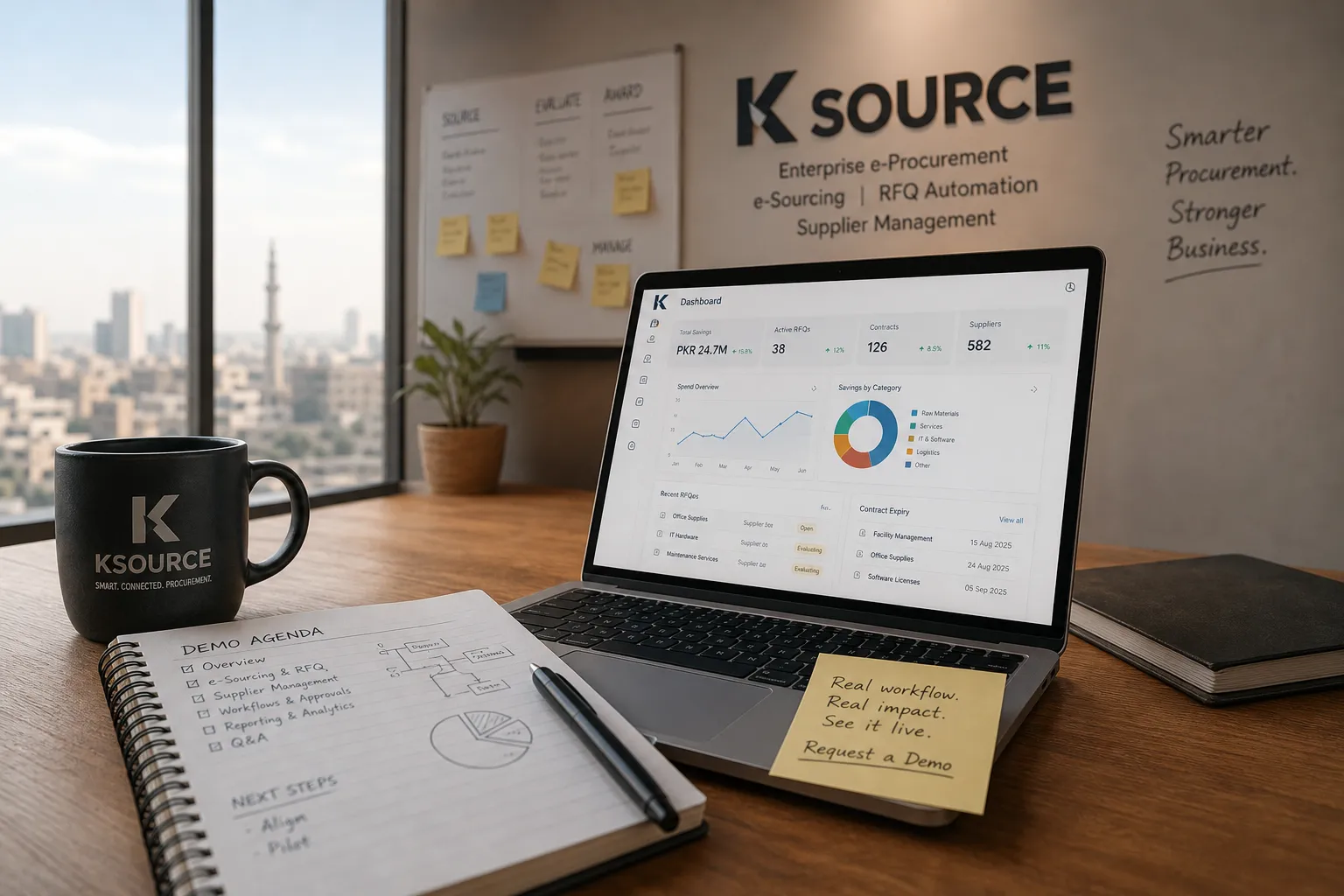
What a demo request should clarify in enterprise procurement
A Request a Demo is not just a sales form. For a Procurement Director, CPO, CFO, Supply Chain Director, or Purchasing Manager, it should be a structured way to test whether an e-procurement platform can support the buying process you actually run: requisitions, RFQs, sealed bidding, supplier participation, approvals, and purchase order workflows. With KSOURCE, the useful question is not simply “what does the software look like?” but “can this workflow reduce friction between enterprise buyers, vendors, and internal approvers without weakening control?”
That distinction matters because enterprise procurement software is rarely bought by one person for one simple task. Finance may care about spend visibility and approval discipline. Procurement may care about RFQ cycle time and vendor response quality. Supply chain teams may care about continuity and supplier coverage. Vendors care about whether the process is clear enough to participate without repeated clarification calls. A good demo should let each stakeholder see the parts of the system that affect their work.
KSOURCE is positioned for enterprise e-procurement, e-sourcing, RFQ automation, supplier management, sealed bidding, no-code workflows, and purchase order workflows. Those terms should become practical demo checkpoints. If the demo never shows how an RFQ is created, how vendors receive and respond, how sealed bidding is handled, or how a request becomes an approval and then a purchase order, the session has stayed too abstract.
Prepare around your procurement workflow, not around software features
The strongest demo requests are specific without becoming a full implementation brief. Before scheduling, identify the procurement flow that creates the most operational drag. For one organisation, that may be RFQs moving through email threads with inconsistent vendor responses. For another, it may be purchase requisitions waiting for manual approval. For a finance-led evaluation, it may be the lack of a clean audit trail across purchasing decisions.
Use that friction to shape the demo agenda. Instead of asking, “Can you show the RFQ module?”, ask, “Can you show how a buyer creates an RFQ, invites approved vendors, receives bids, compares responses, and moves the selected supplier into the next purchasing step?” That wording gives the vendor a real process to demonstrate rather than a menu of screens.
A practical preparation list might include:
- The procurement categories or spend areas you want to test first.
- The number and type of internal approvers involved in a typical purchase.
- How vendors are currently invited, evaluated, and notified.
- Where sealed bidding is required or preferred.
- What information finance needs before a purchase order is issued.
- Any privacy, access, or data-handling questions that must be answered before procurement data is shared.
For broader context on the buyer-side proposition, the For Enterprise Buyers page is the right place to connect the demo conversation with KSOURCE’s buyer audience and platform positioning.
What to ask KSOURCE to show during the demo
A useful KSOURCE demo should move from a real procurement trigger to a clear purchasing outcome. If the session begins with a dashboard, ask what operational decision the dashboard supports. If it begins with a workflow builder, ask who can configure it, where approvals sit, and how changes affect buyers and vendors.
For sealed bidding, ask how the sealed process is preserved in practice and what users can or cannot see before the appropriate stage. If cryptographic sealing is discussed, ask for a plain-language explanation of what is sealed, when it is sealed, and what evidence is visible to administrators and participants.
For no-code workflows, focus on whether procurement teams can configure approval paths without waiting for custom development. A no-code workflow is valuable only if it reflects the way authority works inside your organisation: category thresholds, finance checks, supply chain review, or senior management approval. Ask for a change during the demo, such as adding a finance review above a certain purchase value, and watch whether the workflow can be adapted cleanly.
For vendors, ask what participation looks like from their side. A supplier-facing workflow should make it clear how vendors receive opportunities, submit information, and understand what action is required. If vendors need extensive hand-holding, the buyer’s internal efficiency gain may be reduced by external support work.
When you are ready to move from research to scheduling, use the KSOURCE Request a Demo page rather than relying on a generic inquiry route. That keeps the conversation anchored to the platform evaluation rather than a broad contact request.
Data, privacy, and access questions belong in the first conversation
Procurement demos often focus on speed and automation, but enterprise buyers should also ask how data, roles, and access are handled. Procurement workflows contain commercially sensitive information: supplier pricing, bid documents, evaluation notes, internal approvals, and purchase history. If a demo does not explain who can view what, the evaluation is incomplete.
Ask how buyer users, approvers, and vendor users are separated. Ask whether suppliers can see only their own submissions. Ask how administrators manage access when employees move roles or when a vendor relationship changes. These are not minor configuration details; they affect confidence in sealed bidding, supplier fairness, and internal governance.
It is also sensible to review KSOURCE’s Privacy Policy before sharing sensitive operational information through any form or meeting request. The policy page is the appropriate first-party source for understanding the site’s stated privacy approach. If your organisation has additional procurement, legal, or data-residency requirements, raise them during the demo planning stage rather than after technical evaluation has already started.
What generic demo-page advice misses for procurement buyers
Many pages about “Request a Demo” are written for SaaS marketers who want to improve form conversion. That advice can be useful for website teams, but it does not answer the procurement buyer’s core question: how do we judge whether this system fits a controlled sourcing process?
For example, some ranking demo pages frame the offer around seeing where website content stands or improving a demo request form. That is a different problem from enterprise sourcing. Procurement leaders are not mainly evaluating whether a demo page is persuasive; they are evaluating whether the platform can support RFQ automation, sealed bidding, supplier participation, approvals, and purchasing governance.
The same caution applies to broad trust claims. If a vendor says it is trusted by thousands of organisations, ask what that means for your procurement use case. Does the demo show workflows similar to yours? Does it support your vendor environment? Does it give finance the controls it needs?
This is especially important for medium and large organisations in Pakistan, where procurement processes often involve a mix of formal approval chains, supplier documentation, category-specific sourcing practices, and finance oversight. The demo should speak to those realities directly.
What does “Request a Demo” mean for a Procurement Director?
It means asking the platform provider to show how the software would support your sourcing and purchasing process, not just asking for a product tour. For KSOURCE, that should include RFQ handling, sealed bidding, vendor participation, workflow approvals, and the path toward purchase order activity where relevant.
Who should attend the demo?
At minimum, include someone who owns procurement operations and someone who understands finance or approval control. If supplier onboarding, sealed bidding, or category-specific sourcing is central to the evaluation, include the people who will manage those processes day to day.
Should vendors be considered during the demo?
Yes. Even if vendors do not attend the first session, the buyer should ask what the vendor experience looks like. RFQ automation only works well when suppliers can understand invitations, submit responses correctly, and participate without repeated manual intervention.
What mistakes should buyers avoid?
Avoid asking only for a dashboard tour, skipping privacy questions, or judging the platform by a generic feature list. The better approach is to bring one real procurement flow and ask the provider to demonstrate how that flow would work from request to supplier response to approval.
Your next move with KSOURCE
If you are evaluating enterprise e-procurement software, treat the demo as a working session. Bring one procurement process that is causing delays or control gaps. Ask KSOURCE to show the buyer workflow, the vendor workflow, the approval path, and the evidence trail around sealed bidding or RFQ decisions. The goal is to leave the meeting knowing what the platform can handle, what still needs clarification, and whether the next evaluation step is worth your team’s time.
You can start with the KSOURCE Request a Demo page, or learn more about the company through About KSOURCE. If your team is already comparing e-procurement options, prepare the workflow questions first; the demo will be far more useful when it is tied to the way your organisation actually buys.
