
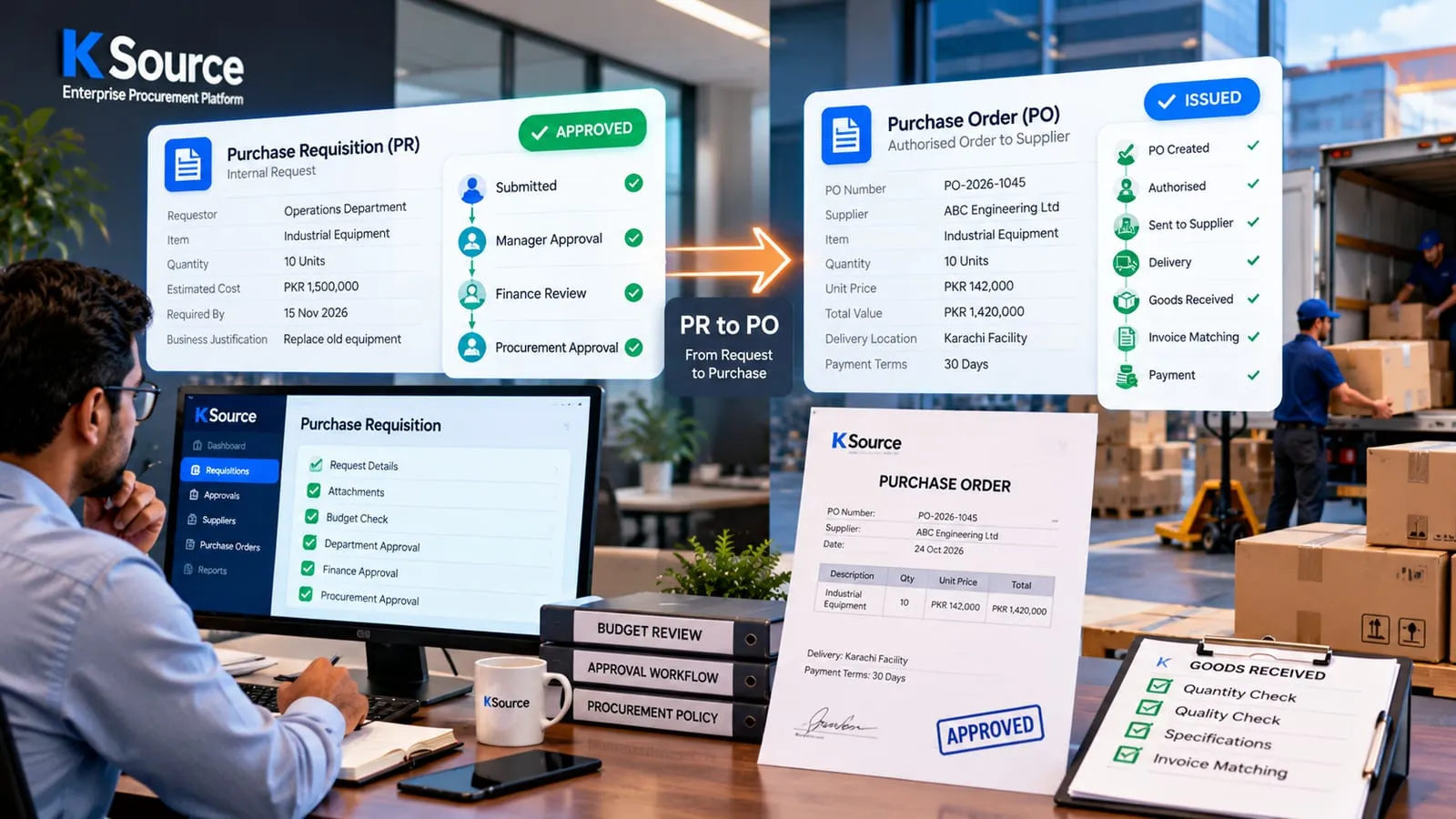
A department needs new equipment. Its manager approves the request, and the procurement team contacts a supplier. But has the company actually placed an order?
Not necessarily.
In enterprise procurement, a purchase requisition and a purchase order represent two different stages of purchasing. One establishes an internal requirement. The other communicates an authorised purchasing commitment to a supplier.
Understanding the difference helps procurement teams maintain budget controls, avoid unauthorised purchases and keep purchasing records consistent.
This guide explains how purchase requisitions and purchase orders work, when each document is required, and how organisations can manage the transition from an internal request to an approved supplier order.
Purchase Requisition vs Purchase Order: The Main Difference
A purchase requisition (PR) is an internal request asking an organisation for permission to purchase goods or services.
A purchase order (PO) is a formal purchasing document issued to a supplier that specifies what the organisation intends to buy and under which commercial terms.
The simplest distinction is:
Purchase requisition = Internal request for approval.
Purchase order = Authorised order sent to a supplier.
Although both documents support purchasing, they serve different purposes and normally involve different participants.
| Feature | Purchase Requisition | Purchase Order |
|---|---|---|
| Primary purpose | Request permission to purchase | Communicate an authorised purchase |
| Primary audience | Internal departments and approvers | Supplier and purchasing organisation |
| Created by | Requesting employee or department | Authorised purchasing function |
| Approval | Normally required before purchasing proceeds | May require additional authorisation before issue |
| Supplier commitment | Does not normally create one | Can create contractual obligations depending on applicable terms and acceptance |
| Typical information | Business need, quantity, estimated cost and justification | Supplier, agreed items, prices, delivery and payment terms |
The exact process varies by organisation. Some purchasing systems also support direct purchase orders for defined categories without requiring a separate requisition.
What Is a Purchase Requisition?
A purchase requisition is an internal document used to request goods or services before a purchase is authorised.
It gives management and procurement teams an opportunity to evaluate whether the purchase is necessary, appropriately budgeted and consistent with company policies.
Information commonly included in a purchase requisition
- Requesting department
- Employee or requester
- Description of required goods or services
- Quantity
- Estimated cost
- Required delivery date
- Business justification
- Budget or cost centre
- Supporting specifications
- Approval status
A purchase requisition does not necessarily identify the final supplier.
In many organisations, supplier selection happens after the internal requirement has been approved.
Example: Manufacturing equipment request
Consider a manufacturing company in Pakistan that needs replacement equipment for its production facility.
The maintenance department submits an internal request with an estimated budget of PKR 1,500,000.
The requisition explains why the equipment is needed, its required specifications and the operational consequences of delaying the purchase.
Finance reviews the available budget, while the relevant manager evaluates the business justification.
Once approved, procurement can begin the sourcing process.
This example is illustrative. It does not represent an actual KSource customer transaction.
What Is a Purchase Order?
A purchase order is a formal document issued by an authorised buyer to a supplier.
It records the goods or services being ordered and the applicable commercial details.
A typical purchase order may contain:
- Purchase order number
- Buyer and supplier information
- Item descriptions
- Quantities
- Unit prices
- Total order value
- Delivery location
- Delivery schedule
- Payment terms
- Applicable taxes
- Relevant contractual references
Unlike a purchase requisition, a purchase order is intended for the supplier.
Whether issuing or accepting a purchase order creates a legally binding agreement depends on the applicable contract terms, acceptance process and governing law.
Purchase order example
Continuing the manufacturing example, assume procurement obtains quotations from qualified suppliers.
After evaluation, the organisation selects a supplier offering equipment for PKR 1,420,000 under acceptable commercial terms.
The purchasing department issues a purchase order specifying the agreed equipment, quantity, delivery conditions and payment arrangements.
The original requisition documented the internal requirement.
The purchase order documents the supplier-facing purchasing decision.
How the PR-to-PO Process Works
In a structured enterprise procurement process, a purchase requisition may pass through several stages before becoming a purchase order.
1. Identify the purchasing requirement
A department identifies goods or services needed to support business operations.
The requester defines the requirement, estimated budget and relevant specifications.
2. Submit the purchase requisition
The request enters the organisation's purchasing approval process.
Supporting documents may include technical specifications, quotations or a business justification.
3. Review and approve the request
Authorised reviewers evaluate whether the purchase is necessary and whether sufficient budget is available.
Depending on the organisation, approval may involve department management, finance and procurement.
4. Select the supplier
If a supplier has not already been selected under an approved purchasing arrangement, procurement may conduct supplier discovery, request quotations or initiate a tender.
The sourcing method depends on purchase value, category, urgency and company policy.
5. Prepare the purchase order
After the required approvals and sourcing decisions, the purchasing team prepares the order using the agreed commercial information.
6. Authorise and issue the purchase order
Some organisations require a final approval before the purchase order is released.
The authorised document is then communicated to the supplier.
7. Receive goods or services
When delivery occurs, the organisation records what was received and identifies any discrepancies.
8. Verify the invoice
Where applicable, finance compares the supplier invoice against the purchase order and receipt records before payment.
This is commonly known as three-way matching.
The precise sequence may differ for service contracts, framework agreements, emergency purchases or other approved purchasing arrangements.
Purchase Requisition Approval vs Purchase Order Approval
Although both documents may require approval, the purpose of each approval is different.
Purchase requisition approval focuses primarily on the business need and authority to proceed.
Purchase order approval focuses on the final purchasing commitment and its commercial terms.
| Approval question | PR stage | PO stage |
|---|---|---|
| Is the purchase necessary? | Primary consideration | Usually established earlier |
| Is budget available? | Initial budget assessment | Final amount may be checked |
| Which supplier is selected? | May be undecided | Normally identified |
| Are commercial terms acceptable? | May be preliminary | Important final consideration |
| Can the order be issued? | Not necessarily | Determined by authorised purchasing controls |
Separating these decisions can improve accountability.
However, excessive approval stages can create delays. Organisations should design approval workflows according to purchasing risk, transaction value and internal governance requirements.
What Happens When Purchase Requisitions and Purchase Orders Are Not Connected?
Disconnected purchasing records can create operational problems.
For example, an employee may obtain approval for one specification while procurement later orders a different product.
Alternatively, the final purchase order may exceed the amount originally approved.
Without a clear relationship between the requisition and order, reviewers may struggle to identify where the change occurred.
Common risks include:
- Purchases exceeding approved budgets
- Orders issued without appropriate authority
- Differences between requested and purchased items
- Duplicate purchasing requests
- Incomplete approval histories
- Difficulty reconciling supplier invoices
- Weak visibility into departmental spending
A consistent PR-to-PO process helps organisations identify these issues before they affect purchasing operations.
Three-Way Matching: Connecting Purchase Orders to Payment
The procurement process does not end when a purchase order is issued.
Before paying an invoice, many organisations verify that the invoiced goods or services correspond to the authorised order and recorded receipt.
Three-way matching compares:
- The purchase order
- The goods receipt or service confirmation
- The supplier invoice
Consider a purchase order for 100 units.
If the organisation receives only 90 units but the supplier invoices 100, the discrepancy may require investigation before payment.
Matching controls can help identify quantity differences, pricing discrepancies and incomplete deliveries.
Not every transaction uses the same matching method. Service procurement and certain contract arrangements may require alternative controls.
Manual PR-to-PO Workflows vs Digital Procurement Systems
Some businesses manage requisitions using spreadsheets, email and manually prepared purchase orders.
These methods may be workable for limited purchasing activity, but they can become difficult to coordinate when transaction volumes and approval requirements increase.
| Process area | Manual workflow | Digital procurement workflow |
|---|---|---|
| Request submission | Email or spreadsheet | Structured digital request |
| Approval routing | Manual forwarding | Configured approval stages |
| Status visibility | Requires manual follow-up | May provide central status tracking |
| Document history | Distributed files and messages | Centralised transaction records |
| Purchase order preparation | Manual document creation | May reuse approved purchasing information |
| Reporting | Manual consolidation | May support procurement reporting |
The benefits of digital procurement depend on the actual system configuration, data quality and adoption.
Software does not automatically eliminate purchasing errors or replace appropriate internal controls.
Where KSource Fits into Enterprise Procurement Workflows
KSource provides an enterprise e-procurement platform designed to connect purchasing activities through structured digital workflows.
Its published platform information describes purchase requisition management, configurable approvals, RFQ processes and purchase order lifecycle capabilities.
These functions are relevant to organisations seeking better coordination between purchasing requests, supplier selection and order management.
Businesses evaluating these processes can explore the KSource enterprise buyer platform.
For a broader overview of the platform, visit KSource procurement platform capabilities.
Organisations should confirm the exact approval configurations, integrations and purchasing controls available for their requirements before implementation.
Common PR-to-PO Mistakes
Issuing purchase orders before required approvals
Orders released without proper authorisation may create financial commitments that have not been reviewed.
Using incomplete purchase requisitions
Missing specifications, delivery requirements or budget information can delay purchasing and create misunderstandings.
Failing to reconcile approved and final amounts
If the final purchase order differs materially from the approved request, additional authorisation may be necessary.
Creating duplicate purchase requests
When departments cannot see existing requests, the same requirement may be submitted more than once.
Ignoring changes after order issue
Changes to quantities, prices or delivery terms should follow appropriate amendment and approval procedures.
Frequently Asked Questions
Can a purchase order be created without a purchase requisition?
Yes. Some organisations allow direct purchase orders for specified purchasing categories or approved arrangements. Whether a requisition is mandatory depends on the organisation's purchasing policy and system configuration.
Is a purchase requisition legally binding?
A purchase requisition is normally an internal document and does not itself establish a supplier-facing purchasing commitment.
Is a purchase order a contract?
A purchase order may form part of a legally binding contract, depending on the applicable terms, supplier acceptance and governing law. It should not automatically be treated as a complete contract in every situation.
Who approves a purchase requisition?
Approval authority depends on the organisation. Department managers, budget owners, finance personnel or other authorised individuals may be involved.
What does PR-to-PO mean?
PR-to-PO refers to the workflow that transforms an internal purchase requisition into an authorised purchase order issued to a supplier.
What happens after a purchase order is issued?
The supplier processes the order, goods or services are delivered, and the organisation records receipt and verifies invoices according to its purchasing and payment controls.
Building a More Reliable Purchasing Process
Purchase requisitions and purchase orders are closely related, but they should not be treated as interchangeable documents.
A requisition establishes the internal purchasing requirement and approval process. A purchase order communicates the authorised commercial transaction to the supplier.
When both stages are connected through consistent records and appropriate controls, procurement teams can improve purchasing visibility and reduce avoidable discrepancies.
For enterprises evaluating digital purchasing workflows, KSource provides procurement capabilities connecting purchase requests, sourcing activities, approvals and purchase order processes.
Explore its enterprise procurement platform to assess how these workflows could support your organisation's purchasing requirements.
