
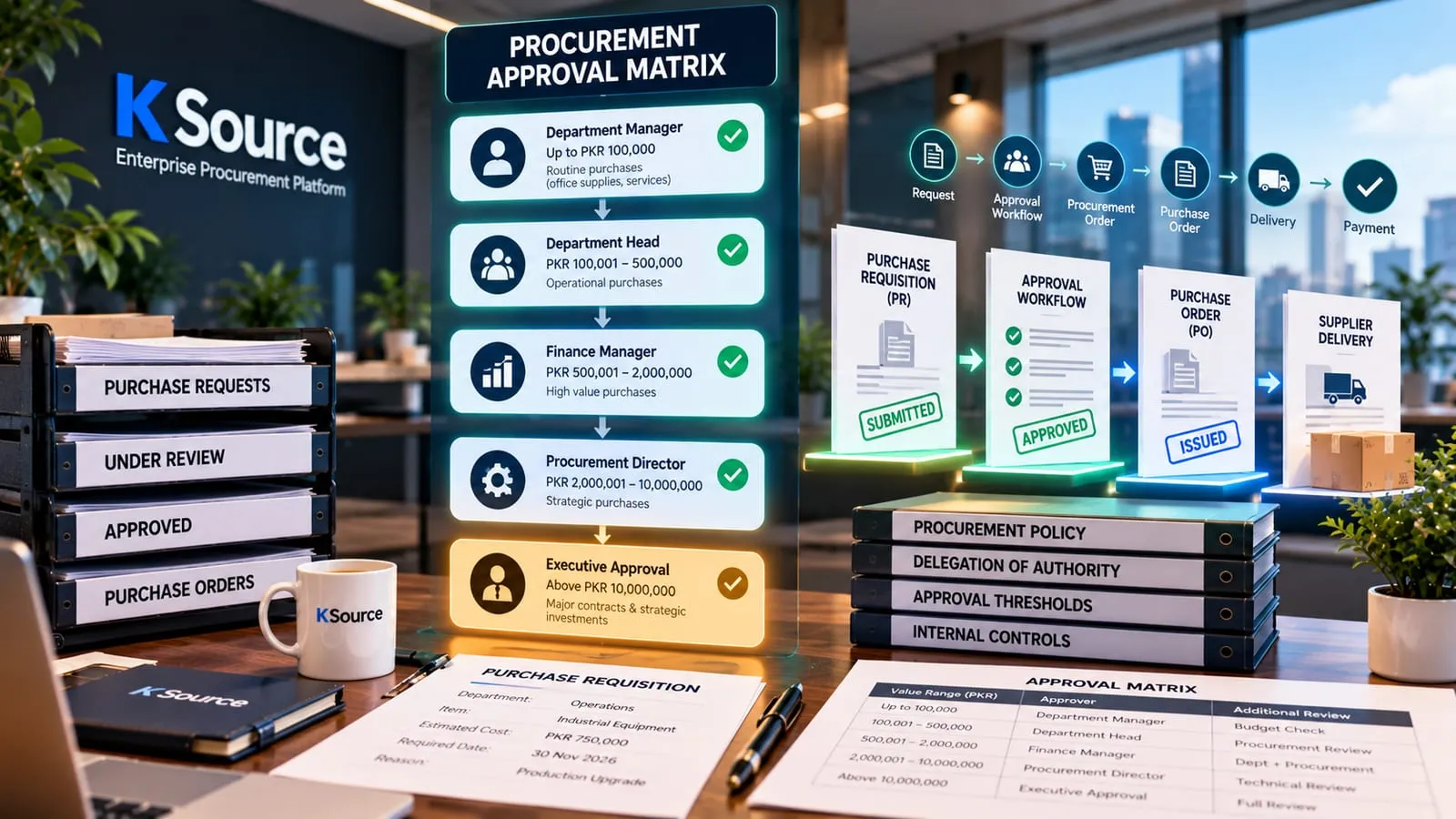
A purchasing request worth PKR 75,000 should not necessarily follow the same approval process as a PKR 15 million equipment contract.
Yet many procurement teams struggle with exactly this problem. Routine purchases wait for senior management, urgent requests move through informal email approvals, and employees are sometimes uncertain about who has the authority to approve a transaction.
The solution is not simply adding more approval stages.
It is designing a procurement approval matrix that connects purchasing authority to transaction value, business risk and organisational responsibility.
A well-designed matrix makes it clear who can approve a purchase, when additional review is required and how exceptions should be handled.
This guide explains how procurement approval matrices work, provides practical examples and examines how enterprises can maintain financial controls without creating unnecessary purchasing delays.
What Is a Procurement Approval Matrix?
A procurement approval matrix is a documented framework that defines which individuals or organisational roles have authority to approve purchasing transactions.
Approval requirements may depend on:
- Purchase value
- Department or business unit
- Available budget
- Purchasing category
- Supplier risk
- Contract duration
- Regulatory or compliance requirements
- Type of purchasing commitment
The matrix helps establish a consistent relationship between purchasing decisions and delegated authority.
For example, a department manager may be authorised to approve routine purchases within a defined limit, while larger transactions require finance or executive approval.
The objective is to ensure that purchasing commitments are reviewed by the appropriate people without requiring unnecessary intervention in every transaction.
Why Enterprises Need Defined Purchasing Authority
Procurement approvals protect more than company budgets.
They establish accountability for purchasing decisions and help ensure that employees act within their authorised responsibilities.
Without clearly defined approval rules, organisations may experience several problems.
Unclear spending authority
Employees may not know whether their manager, finance department or procurement director must approve a purchase.
Unnecessary approval delays
Low-value purchases may wait for executives who should be concentrating on higher-risk decisions.
Purchasing outside approved budgets
Transactions may proceed without sufficient review of the relevant budget or cost centre.
Weak accountability
When approvals happen through informal conversations, reconstructing who authorised a decision can become difficult.
Inconsistent purchasing practices
Different departments may apply different approval standards to similar transactions.
A documented approval matrix helps address these problems by defining authority before purchasing requests arise.
Procurement Approval Matrix Example
Consider a fictional manufacturing enterprise operating in Pakistan.
The company wants routine purchases approved quickly while maintaining stronger controls over major financial commitments.
It could establish the following illustrative approval structure.
| Purchase value | Required approval | Additional review |
|---|---|---|
| Up to PKR 100,000 | Department manager | Budget availability |
| Above PKR 100,000 to PKR 500,000 | Department head | Procurement review |
| Above PKR 500,000 to PKR 2,000,000 | Finance manager | Department and procurement approval |
| Above PKR 2,000,000 to PKR 10,000,000 | Finance director | Technical and commercial review where relevant |
| Above PKR 10,000,000 | Chief executive or designated committee | Enhanced financial and procurement review |
Important: These thresholds are illustrative examples, not legal requirements or recommended universal limits for Pakistani businesses.
Actual approval limits should be established according to the organisation's size, governance structure, financial exposure and applicable requirements.
The example also assumes that approval roles are properly authorised and that the requesting employee cannot approve their own purchase where segregation-of-duties controls require independence.
How to Design a Procurement Approval Matrix
1. Identify purchasing categories
Begin by identifying the main types of purchases made by the organisation.
Examples include:
- Office supplies
- Industrial equipment
- Professional services
- IT hardware and software
- Maintenance contracts
- Construction services
- Emergency operational purchases
Different categories may require different levels of technical, financial or compliance review.
A routine consumables purchase does not necessarily require the same evaluation as specialised machinery.
2. Establish financial authority limits
Determine which organisational roles are authorised to approve different transaction values.
These limits should align with the company's formal delegation-of-authority policy.
Where purchasing authority has already been established, the procurement matrix should implement those approved limits rather than creating a conflicting structure.
3. Define departmental responsibilities
Identify which teams must participate in each purchasing decision.
For example:
- Requesting department: confirms business need.
- Budget owner: confirms budget availability.
- Procurement: reviews sourcing requirements.
- Technical team: evaluates relevant specifications.
- Finance: reviews financial exposure.
- Authorised management: approves the commitment.
These responsibilities may be combined or separated depending on organisational size and internal controls.
4. Introduce risk-based approvals
Purchase value alone does not determine procurement risk.
A relatively inexpensive service involving sensitive business data may require more scrutiny than a higher-value routine purchase from an established supplier.
Approval rules should therefore consider risk indicators such as:
- Supplier qualification status
- Access to confidential information
- Operational criticality
- Contractual liabilities
- Regulatory requirements
- Unusual payment conditions
5. Define exceptions and escalation rules
Not every transaction will fit the standard approval process.
Organisations should establish documented procedures for unusual circumstances, including emergency purchases, absent approvers and material changes to approved transactions.
6. Establish an audit record
Approval records should make it possible to determine who reviewed a transaction, what information was available and when the decision occurred.
Relevant supporting records may include the purchasing request, budget confirmation, supplier evaluation and final authorisation.
Approval Matrix vs Delegation of Authority
Procurement approval matrices and delegation-of-authority policies are closely related, but they are not identical.
A delegation-of-authority policy defines which roles have permission to make specified organisational commitments.
A procurement approval matrix translates that authority into practical purchasing approval rules.
| Area | Delegation of authority | Procurement approval matrix |
|---|---|---|
| Primary purpose | Defines authorised decision-making powers | Routes purchasing decisions to authorised roles |
| Scope | May cover contracts, finance and other decisions | Focuses on purchasing transactions |
| Typical format | Corporate policy or authority schedule | Approval table or configured workflow |
| Key control | Authority limits | Correct approval routing |
A procurement workflow should not allow an individual to approve a transaction beyond their formally delegated authority.
Three Procurement Approval Scenarios
Scenario 1: Routine office equipment
A department requests office equipment worth PKR 80,000.
Under the illustrative matrix, the department manager may approve the purchase after confirming budget availability.
The transaction does not automatically require executive approval.
This approach helps avoid unnecessary escalation for routine spending.
Scenario 2: Industrial equipment purchase
A manufacturing department requests machinery worth PKR 4,500,000.
The purchase requires technical specifications, supplier evaluation and financial authorisation.
The approval process may involve engineering, procurement and finance before the authorised decision-maker approves the commitment.
This is a different risk profile from routine office purchasing.
Scenario 3: Emergency maintenance
A production line stops unexpectedly, and a critical replacement component is required.
The organisation's standard approval process may not be suitable for the operational urgency.
However, urgency should not automatically eliminate purchasing controls.
An established emergency procedure could identify an authorised emergency approver, required documentation and subsequent independent review.
The exact process must follow the organisation's approved policies.
All three scenarios are illustrative and do not represent actual KSource customer transactions.
Preventing Approval Bottlenecks
An approval matrix should improve purchasing control without making every transaction unnecessarily complicated.
Common causes of approval delays include:
- Too many approval stages
- Unclear decision ownership
- Missing purchasing information
- Unavailable approvers
- Repeated reviews of unchanged information
- Inconsistent departmental rules
Several practical measures can help.
Use proportionate approval levels
Reserve senior management attention for transactions that justify additional oversight.
Define alternate approvers
Where company policy permits, authorised delegates can handle requests when the primary approver is unavailable.
Require complete purchasing information
Requests containing clear specifications, budgets and supporting documents are easier to review.
Measure approval delays
Track how long requests remain at each approval stage.
Review recurring bottlenecks to determine whether they result from missing information, insufficient authority coverage or unnecessarily complex procedures.
Why Segregation of Duties Matters
Segregation of duties is an important principle of procurement governance.
It involves separating responsibilities that could create excessive control or conflicts of interest if assigned to one individual.
For example, an organisation may separate:
- Purchase request creation
- Purchase approval
- Supplier master-data changes
- Goods receipt confirmation
- Invoice authorisation
- Payment execution
The appropriate separation depends on organisational size, risk and internal policy.
Smaller businesses may need compensating controls where complete separation is impractical.
The Chartered Institute of Procurement & Supply identifies clear authority limits and segregation of duties as important elements of ethical procurement practice.
Manual vs Automated Procurement Approval Workflows
Approval matrices can be implemented manually or through digital procurement systems.
Manual workflows may use spreadsheets, email and signed purchasing forms.
Digital workflows can help organisations apply configured rules and maintain structured approval records.
| Capability | Manual process | Digital workflow |
|---|---|---|
| Approval routing | Manual forwarding | Rules-based routing where supported |
| Spending thresholds | Checked by reviewers | Can be evaluated automatically |
| Approval status | Email follow-up | Centralised status tracking |
| Supporting documents | Distributed files | Linked transaction records |
| Audit history | Manual recordkeeping | System-generated activity records |
| Rule changes | Manual policy updates | Configurable rules where available |
Automation does not eliminate the need for good procurement governance.
Poorly designed rules can automate the wrong approval decisions just as consistently as well-designed rules can support appropriate controls.
How KSource Supports Configurable Procurement Approvals
KSource describes a no-code workflow engine that allows enterprise procurement teams to configure approval routing, financial thresholds and compliance requirements.
According to its published buyer documentation, the platform supports multi-level approval structures and workflow configuration without requiring custom scripting for every rule change.
KSource also describes purchase requisition management, RFQ workflows, comparative statements and purchase order processes.
These capabilities are relevant to enterprises seeking to connect purchasing requests with appropriate financial and operational approvals.
Businesses evaluating configurable procurement workflows can explore the KSource enterprise buyer solution.
For an overview of the broader procurement lifecycle, visit the KSource procurement platform.
Specific approval configurations, integrations and exception-handling capabilities should be confirmed through a product demonstration.
Common Procurement Approval Matrix Mistakes
Using spending value as the only approval criterion
Risk, supplier status and contractual complexity may justify additional review even when a purchase falls below a financial threshold.
Allowing employees to approve their own purchases
Self-approval can undermine segregation-of-duties controls where independent authorisation is required.
Ignoring cumulative purchasing commitments
Multiple related transactions may create greater financial exposure than an individual purchase suggests.
Splitting purchases to avoid approval thresholds
Artificially dividing a requirement into smaller transactions can undermine delegated spending controls.
Failing to update approval authority
Organisational restructuring, employee departures and changes in responsibilities may require approval rules to be reviewed.
Creating unnecessary approval stages
Excessive reviews can delay routine purchasing without materially improving risk management.
Procurement Approval Matrix Implementation Checklist
- Document the organisation's purchasing policies.
- Identify authorised purchasing roles.
- Confirm formal delegation-of-authority limits.
- Define transaction-value thresholds.
- Identify risk-based approval requirements.
- Separate conflicting purchasing responsibilities.
- Establish exception and escalation procedures.
- Define authorised alternate approvers.
- Document approval evidence requirements.
- Test approval scenarios before implementation.
- Train employees and approvers.
- Review approval performance and exceptions periodically.
The matrix should be treated as a controlled governance document rather than a one-time configuration exercise.
Frequently Asked Questions
What is a procurement approval matrix?
A procurement approval matrix defines which organisational roles are authorised to approve purchasing transactions based on factors such as purchase value, department, risk and business requirements.
Who should approve purchase orders?
Purchase orders should be authorised by individuals or roles with appropriate delegated purchasing authority. The exact approval requirements depend on the organisation's policies.
Can procurement approvals be automated?
Yes. Digital procurement systems can support rules-based approval routing, spending thresholds, status tracking and approval records. The available capabilities depend on the platform and its configuration.
What is a multi-level procurement approval?
A multi-level approval requires a purchasing request to pass through more than one authorised reviewer. For example, a transaction may require departmental, financial and executive approval.
How often should an approval matrix be reviewed?
Review frequency should reflect organisational policy and risk. Changes in authority, organisational structure, purchasing patterns or compliance requirements may justify an earlier review.
Better Purchasing Controls Start with Clear Authority
A procurement approval matrix should help employees make appropriate purchasing decisions without creating unnecessary administrative delays.
The most effective approach connects spending limits, organisational responsibilities and risk-based controls within a consistent approval framework.
When supported by clear policies and reliable records, purchasing approvals can become more transparent, accountable and manageable.
For enterprises evaluating configurable procurement workflows, KSource provides digital purchasing capabilities that connect requisitions, approvals, sourcing and purchase orders.
Explore the platform to assess how its approval workflows can support your organisation's purchasing requirements.
