
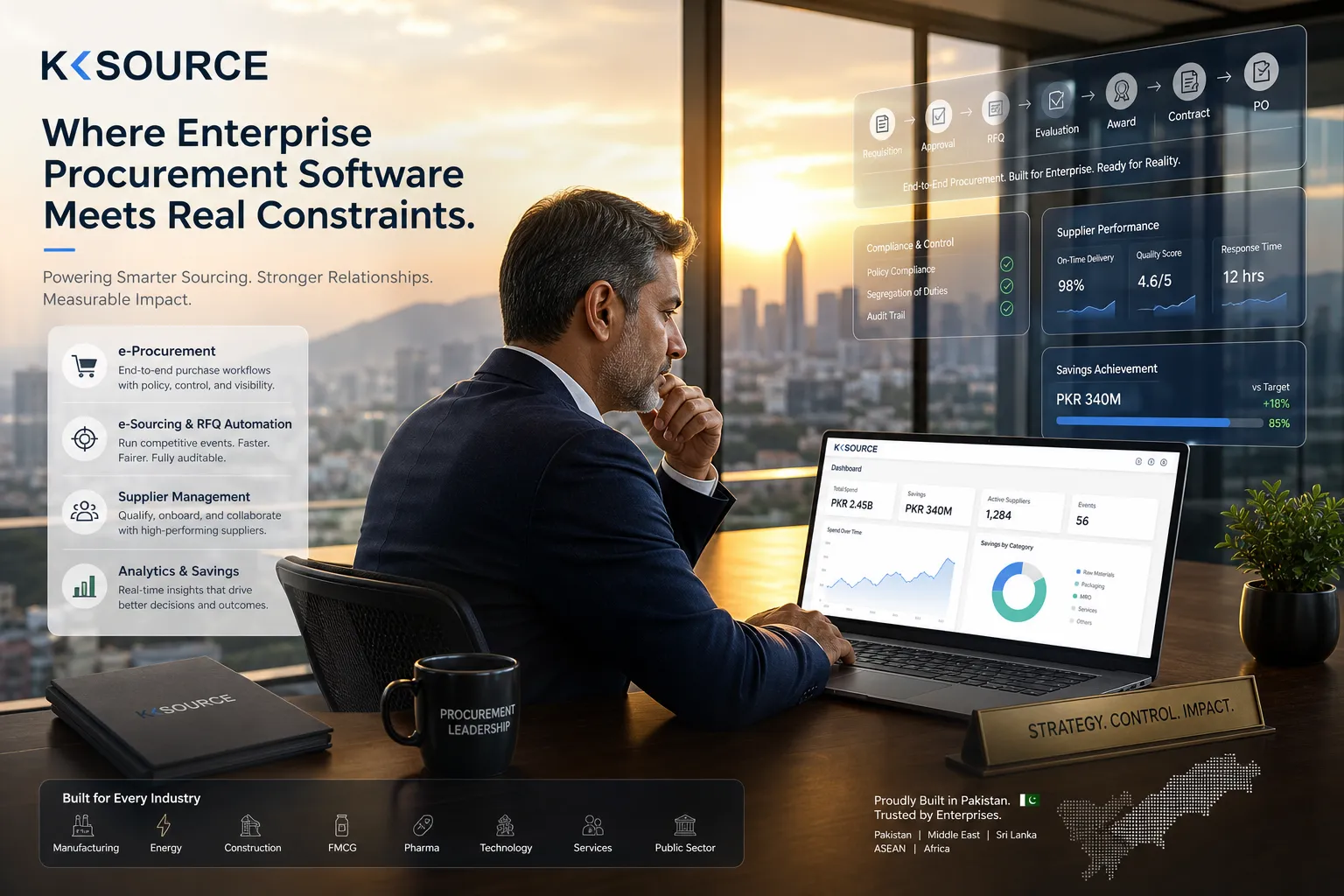
What enterprise procurement software means in practice
Enterprise procurement software is not just a digital form for buying goods and services. For a procurement director, CPO, finance leader, or supply chain head, it is the operating system for sourcing, RFQs, supplier participation, approvals, sealed bidding, purchase orders, and audit-ready decision records. The real test is whether it can handle the way medium and large organisations in Pakistan actually buy: multiple departments, urgent requests, vendor qualification, finance scrutiny, negotiated offers, and a need to prove why one supplier was selected over another.
That definition matters because many procurement tools look similar at first glance. A small purchasing app may help a team raise requisitions. An enterprise e-procurement platform has to manage the full buying path: collecting demand, inviting qualified vendors, running RFQs, protecting bid integrity, comparing offers, recording approvals, and converting the selected offer into the next purchasing step.
KSOURCE sits in this enterprise e-procurement space with RFQ management, sealed bidding, a vendor marketplace, procurement workflows, and purchase order workflows. Its buyer-facing context is relevant for organisations that need more than a spreadsheet and more structure than email chains. The goal is not to make procurement look digital; it is to make decisions easier to run, easier to review, and harder to dispute later.
Procurement simplified does not mean procurement made loose
The phrase “procurement simplified” can be misleading if it is treated as a promise to remove controls. Enterprise procurement software should simplify the work without weakening the discipline. A purchasing manager still needs clear specifications, comparable bids, documented approvals, and supplier accountability. What changes is the amount of manual chasing required to get there.
That is not just inefficient; it creates avoidable risk. A missed email, an outdated quote, or an unclear approval can affect the credibility of the purchase.
A practical system simplifies procurement by standardising repeatable steps. For example, an RFQ should carry the item or service requirement, submission deadline, vendor list, bid conditions, comparison details, and approval trail in one controlled flow. KSOURCE’s RFQ and sealed bidding capabilities are especially relevant where fairness and defensible supplier selection matter. For a deeper treatment of RFQ decision discipline, KSOURCE’s guide on turning an RFQ management system into decisions you can defend expands on why the record around the decision is as important as the price itself.
The point is not to automate every judgment. Procurement still needs commercial sense: whether a supplier understands the scope, whether delivery terms are realistic, whether after-sales support matters, and whether the lowest price introduces hidden risk. Good software reduces clerical friction so the team can spend more time on those judgments.
Centralized procurement management starts with one source of truth
Centralized procurement management is often where enterprise software proves its value. In many organisations, procurement activity is scattered across business units, plant locations, campuses, hospitals, branches, or project teams. Each may have its own supplier contacts, approval habits, and informal shortcuts. That fragmentation makes spend harder to see and supplier performance harder to compare.
A centralised system gives procurement and finance a shared view of what is being requested, which vendors are participating, which bids are active, which approvals are pending, and which purchases have moved forward. This is particularly important in Pakistan-based enterprises where buying may involve local supplier markets, imported components, project-based purchasing, and finance controls that require clear documentation before payment or order issuance.
Centralisation is also useful for vendors. A supplier portal or structured vendor participation model reduces the ambiguity of “send us your quote by email and we will get back to you.” Vendors can respond to the defined requirement, follow the submission rules, and avoid guessing whether the latest clarification was shared with everyone. That improves process quality for buyers and reduces avoidable confusion for suppliers.
For enterprise buyers evaluating KSOURCE, the For Enterprise Buyers page is the most relevant starting point because it frames the platform around the buyer’s role in digital procurement rather than treating procurement as a generic administrative task.
Growth requires configurable workflows, not one rigid process
This is where workflow design matters. Some purchases need a simple RFQ and approval. Others need technical evaluation before commercial opening. Some require sealed bidding, while others need supplier onboarding before invitation. Some purchases must pass through finance before a PO is created. A platform with no-code workflows can be useful when procurement teams need to adjust process logic without waiting for a custom development cycle for every operational change.
Growth also affects supplier management. It is one thing to buy from a familiar supplier list; it is another to expand into new categories, onboard new vendors, and maintain a consistent approval method. The practical question is not “Can we add suppliers?” but “Can we verify, approve, classify, and invite suppliers in a way procurement and finance can trust?” KSOURCE’s guide to the supplier onboarding process is useful for teams thinking through verification and approval before they scale digital sourcing.
A common mistake is buying software only for the current pain: too many emails, too many spreadsheets, too much follow-up. Those problems matter, but enterprise procurement software should also be judged by the next layer of complexity. If the organisation expands categories, locations, approval levels, or supplier participation, the system should not become another bottleneck.
Control lives in the details: sealed bids, approvals, and audit trails
Enterprise procurement control is not a single approval button.
Sealed bidding is particularly important where the buyer must show that suppliers competed under fair conditions. If bids are opened casually, forwarded informally, or revised without a clear record, the procurement team may still make a reasonable decision but struggle to defend it later. Cryptographically sealed bidding, where relevant to the platform’s implementation, is designed to strengthen trust in the submission and opening process. The practical buyer question is simple: can the system show what happened, when it happened, and who had access?
Approvals need the same discipline. If approval happens outside the system, the record becomes split. If approval happens inside a structured workflow, the organisation is better positioned to review the decision later.
Data handling is also part of control. Procurement platforms process commercially sensitive supplier and buyer information, so decision-makers should review how privacy and data practices are presented. KSOURCE provides a public Privacy Policy, which is a sensible document to include in internal review when procurement, finance, IT, or legal teams are assessing any SaaS platform.
Delivering value across different buying environments
The value of enterprise procurement software changes by business context. In construction, the issue may be quote comparability across subcontractors and material suppliers. In manufacturing, it may be repeat categories, stock-sensitive timing, and vendor reliability. In healthcare, supplier qualification and documentation can carry more weight. In education or nonprofit environments, transparency and approval discipline may be central. In technology or food service, speed and supplier responsiveness may matter more, but not at the cost of weak records.
A ranked list can help with market awareness, but it cannot decide whether a platform fits your approval hierarchy, supplier base, bidding rules, or category complexity. A better evaluation starts with the purchases that create the most friction today.
Useful evaluation questions include:
- Which categories generate the most RFQs, clarifications, or supplier disputes?
- Where do approvals slow down: requester, procurement, technical evaluator, finance, or senior management?
- Do suppliers submit bids in a controlled format, or does the team spend time normalising quotations?
- Can the organisation explain why the winning vendor was selected without reconstructing the process from email?
- Does the platform support the level of sealed bidding, supplier management, and workflow control the organisation actually needs?
For vendors, the question is also practical: will the platform make participation clearer? Vendors benefit when requirements, deadlines, bid conditions, and submission rules are not hidden across scattered messages. A cleaner process can reduce avoidable back-and-forth and help suppliers compete on the substance of their offer.
What to check before selecting a platform
Before committing to enterprise procurement software, buyers should be honest about the constraints that technology cannot magically remove. Poor specifications will still produce weak bids. Unverified supplier data will still create risk. A digital workflow will not fix unclear authority levels. If a purchase category needs technical evaluation, the software should support that process, but the organisation still has to define who evaluates and on what basis.
There are also practical adoption questions. Will requesters use the system, or will they continue sending informal messages? Are vendors ready to submit through a portal? Does finance trust the approval data? Has procurement defined standard RFQ templates for common categories? If the answer is no, the rollout should include process cleanup, not just platform access.
A sensible starting approach is to choose a few high-friction procurement flows and map them end to end. For each flow, write down the trigger, required information, vendor invitation rules, bid submission method, evaluation steps, approval path, and PO handoff. Then test whether the software can support that flow cleanly. This makes the discussion concrete and avoids selecting a platform based only on broad feature labels.
What does enterprise procurement software mean for a procurement director?
It means a controlled system for running sourcing and purchasing activity across departments, suppliers, approvals, and records. The director should be able to see where requests stand, whether RFQs are properly managed, how vendors participated, and why a supplier decision was approved.
How should an organisation get started without overcomplicating the rollout?
Start with the procurement flows that cause the most friction: repeated RFQs, high-value purchases, supplier onboarding, or approvals that frequently stall. Define the current process, remove unnecessary manual steps, then configure the platform around the workflow you want to enforce.
Do we need a custom procurement setup?
Possibly, but “custom” should not mean rebuilding the whole process from scratch. Many enterprises need configurable workflows, category-specific RFQ templates, approval levels, and supplier controls. The best next step is to document your buying rules and compare them against the platform’s workflow capabilities.
What mistakes should buyers avoid?
Avoid choosing software only because it digitises forms. Also avoid ignoring vendor experience, leaving supplier verification undefined, or keeping approvals outside the system. Those gaps can recreate the same confusion the platform was meant to solve.
Your next move with KSOURCE
The strongest procurement software decision begins with a clear view of your real constraints: supplier participation, sealed bidding needs, approval authority, audit records, and PO workflow. Once those are visible, platform evaluation becomes much easier because the discussion moves from “which tool has more features?” to “which system can run our procurement process with discipline?”
KSOURCE is built around enterprise e-procurement, RFQ automation, supplier participation, sealed bidding, and workflow control for buyers and vendors using digital procurement. If your organisation is reviewing procurement software for a Pakistan-based or regional enterprise environment, start by mapping one important RFQ flow and one supplier onboarding flow. Then use those flows to assess fit in a live discussion.
You can learn more about the company on the About page or request a demo to review how KSOURCE would handle your procurement process in practice.
