
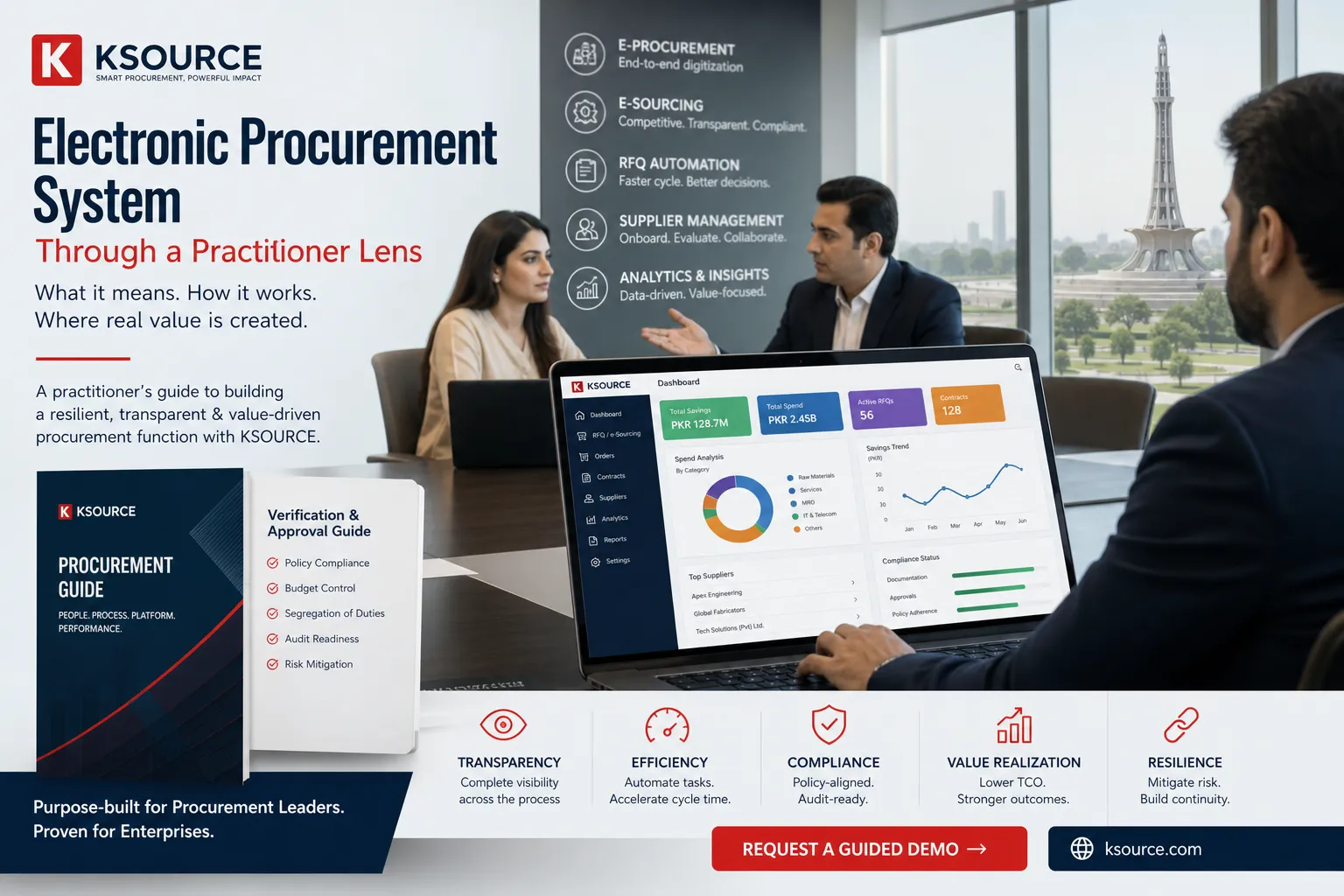
What an electronic procurement system means in practice
An electronic procurement system is not just a digital form for buying goods and services. For a procurement director, CPO, CFO, or supply chain leader, it is the operating layer that moves a requirement from request to RFQ, supplier participation, bid evaluation, approval, award, and record keeping with less manual chasing and more control.
The practical test is simple: can your team explain who requested the purchase, which suppliers were invited, how quotations were received, when bids were opened, who approved the decision, and what evidence supports the award? If the answer depends on searching inboxes or asking one person who “handled it”, the process may be digital in pieces but not yet controlled as an electronic procurement system.
For operators, the system should answer four working questions:
Can we source from the right supplier base? The supplier list should be usable, verified, and segmented enough for the category being purchased.
Can we run RFQs consistently? Requirements, deadlines, attachments, clarifications, and submissions should sit in one traceable workflow.
Can we protect bid integrity? For sensitive procurement, sealed bidding helps prevent premature visibility into supplier offers. KSOURCE’s guide to sealed bidding vs open bidding explains where each model fits.
Why supplier onboarding is the first control point
Many procurement problems begin before the RFQ is issued. A supplier is added informally because someone has worked with them before. A company name is entered differently across departments. A vendor is invited for a category they cannot properly serve. Later, when a bid is submitted or a purchase order is needed, the team discovers missing documentation, unclear tax status, capacity doubts, or conflicting contact details.
Supplier onboarding is the point where an enterprise decides whether a vendor should be allowed into the procurement environment, for which categories, and under what conditions. In an electronic procurement system, onboarding should not be a one-time data entry exercise. It should be a controlled process that captures identity, documentation, category fit, contact ownership, and approval status before the supplier participates in sourcing events.
This is especially important in Pakistan’s enterprise buying environment, where procurement teams often deal with a mix of manufacturers, distributors, service providers, contractors, and regional vendors. Some categories need broad competition; others need stricter qualification. A stationery supplier and an engineering maintenance contractor should not pass through the same depth of review. The system should let procurement set rules without rebuilding the workflow every time.
KSOURCE’s Supplier Onboarding Process guide focuses on verification and approval because onboarding only becomes useful when it reduces uncertainty for the next step. A verified supplier record helps the RFQ team invite relevant vendors, helps finance review vendor information, and helps approvers understand whether a supplier is eligible before price becomes the only discussion.
What supplier onboarding should include
At a practical level, supplier onboarding is the collection and approval of the information your organisation needs before a supplier can quote, bid, or transact. It should be clear enough for vendors to complete without repeated calls, and strict enough for procurement and finance to rely on later.
A useful onboarding flow normally covers:
Business identity: registered business name, trading name if different, address, ownership or authorised contact details, and the documents your organisation requires for verification.
Tax and finance information: tax registration details where applicable, payment-related information, and any finance documents required by your internal policy.
Category and capability: goods or services offered, service locations, delivery ability, industry experience, and capacity indicators relevant to the category.
Compliance and approval status: internal review outcome, expiry of documents where applicable, and whether the supplier is active, pending, blocked, or limited to certain categories.
Communication ownership: the people authorised to receive RFQs, submit bids, respond to clarifications, and handle commercial communication.
The mistake is to treat all of this as static master data. In real procurement, supplier records should influence action. If a vendor is approved only for IT hardware, the system should not casually invite them into a civil works RFQ. If a required document is expired or missing, the issue should be visible before award discussions. If a supplier has multiple contacts, the sourcing team should know who is authorised to respond.
Why verification matters before the RFQ goes out
Verification matters because the RFQ stage is where time pressure increases. Once a department needs material, equipment, services, or project support, procurement is judged on speed as well as control. If supplier checks begin after bids are received, the team risks delays, rework, and uncomfortable award discussions.
Say a manufacturing company needs urgent maintenance parts. Procurement issues an RFQ to several vendors pulled from old records. The lowest quote arrives from a supplier whose business details are incomplete, whose category approval was never reviewed, and whose delivery ability is uncertain. At that point, the team has a bad choice: delay the award for verification, accept risk for the sake of speed, or restart the sourcing event. None of these outcomes is ideal, and all of them are avoidable with better onboarding discipline.
Verification also protects bid fairness. Suppliers are more likely to trust a process when participation rules are clear and applied before pricing is opened. For sealed events, this becomes even more important. The purpose of sealed bidding is not only to hide bids until the correct stage; it is to support a fair process where suppliers understand that competing offers are not being viewed or used prematurely. KSOURCE’s material on sealed and open bidding is useful for teams deciding when confidentiality should be stricter and when visibility may be acceptable.
Verification is not the same as creating unnecessary bureaucracy. The goal is proportionate control. A low-risk routine purchase may need a lighter supplier check. A high-value, technical, or strategically sensitive purchase should require stronger verification, clearer approvals, and a more disciplined RFQ path.
Step 1: establish the supplier’s business identity
The first practical step is to make the supplier’s identity unambiguous. Procurement teams often underestimate this because they recognise vendors by market name, sales representative, or previous relationship. Systems need cleaner records than memory does.
Start with the legal or registered business name, operating name if different, physical address, official contact points, and the documents your organisation requires. In Pakistan, many enterprise teams will also expect finance and tax-related identifiers where applicable, but the exact requirement should follow your internal policy and the nature of the supplier. The key is consistency: every supplier should be captured in the same structure, even if the depth of review changes by category or risk.
Identity checks should also answer who is allowed to act for the supplier. The person who submitted a quotation may not be the person authorised for commercial commitments. The sales contact may not be the finance contact. If RFQs, clarifications, bid submissions, and award communication go to the wrong people, disputes become easier and accountability becomes weaker.
In an electronic procurement system, identity fields should not be buried as optional notes. They should support workflow decisions: whether the supplier can be invited, whether more documents are needed, whether approval is pending, and whether the vendor is active for a category. This is where no-code procurement workflows are valuable: the organisation can define its own approval routing without depending on informal manual follow-up for every exception.
Step 2: assess capability before inviting suppliers
After identity comes capability. A supplier may be real, properly documented, and still not suitable for a specific RFQ. Capability assessment helps procurement avoid shallow competition, where five suppliers are invited but only one or two can actually deliver.
Capability should be assessed against the buying category. For goods, the team may need to know product lines, stock or sourcing ability, delivery coverage, warranty handling, and whether the supplier is a manufacturer, distributor, or reseller. For services, the review may focus on technical skill, project experience, staffing, service area, response time, and required certifications if your internal policy demands them. The point is not to collect every possible document. The point is to collect enough relevant evidence to invite the right vendors.
This assessment becomes more useful when it is connected to RFQ automation. If the procurement team is preparing a technical RFQ, the system should make it easier to select vendors approved for that category and location rather than searching through a generic supplier spreadsheet. KSOURCE’s RFQ-focused guidance, Turning RFQ Management System Into Decisions You Can Defend, is relevant here because RFQ management is not just about sending requests faster; it is about building a decision trail that can survive review.
A good capability check also improves supplier experience. Vendors should not be invited into irrelevant tenders, asked for the same information repeatedly, or left unclear about why they were not eligible. A cleaner supplier marketplace helps buyers find suitable options and helps vendors participate where they are genuinely qualified. For marketplace-style sourcing, KSOURCE’s article on the B2B procurement marketplace explains how supplier participation can be turned into clearer buying decisions.
Where sealed bidding, open bidding, and approvals fit
Once suppliers are onboarded and qualified, the procurement method matters. Open bidding and sealed bidding are not interchangeable labels; they create different expectations for visibility, competition, and control.
Open bidding generally suits situations where broader visibility and active participation are acceptable. It can help when the buying team wants suppliers to compete more openly, depending on the organisation’s rules and the nature of the purchase. Sealed bidding is more appropriate when bid confidentiality is central to fairness, especially where price and commercial terms should remain hidden until the submission deadline or a defined opening stage.
For procurement leaders, the important question is not “Which method sounds more modern?” It is “Which method protects this purchase?” A routine category with many suppliers may benefit from a different structure than a high-value sourcing event where premature bid visibility would damage trust. KSOURCE supports sealed bidding as part of its e-procurement approach, but the method should still be selected according to the procurement scenario, risk level, and internal policy.
Approvals then bring the process back under management control. If every purchase needs senior sign-off, buying slows down. If too many purchases bypass review, spend control weakens. A procurement approval matrix helps define who can approve what, at which value or category level. KSOURCE’s guide to the procurement approval matrix is useful for teams that want clearer authority without turning every RFQ into a manual escalation.
What is the difference between an electronic procurement system and simple purchasing software?
Simple purchasing software may digitise requests or purchase orders. An electronic procurement system should connect sourcing, supplier onboarding, RFQs, bid submission, approvals, and records. The difference is the workflow and evidence trail, not just the fact that the process happens on a screen.
How should a procurement team get started?
Start with the process that creates the most rework or risk. For many enterprises, that is supplier onboarding, RFQ management, or approval routing. Map the current steps, identify where information is missing, and convert those points into required fields, approval rules, and supplier status controls.
What mistakes should be avoided?
Do not automate a weak process without fixing the control points. Common mistakes include inviting unverified suppliers, using the same onboarding requirements for every category, treating sealed bidding as a cosmetic feature, and keeping approvals outside the system in email or messaging apps.
Does every purchase need sealed bidding?
No. Sealed bidding is valuable when confidentiality and fairness are important to the procurement event. Some purchases may be better suited to open bidding or simpler RFQ workflows, depending on value, category, urgency, and internal policy.
Your next move with KSOURCE
The best way to evaluate an electronic procurement system is to test it against your real buying flow, not a generic feature checklist. Take one recent RFQ and ask: were the suppliers verified before invitation, were bids received in a controlled way, was the approval path clear, and can the final decision be defended without reconstructing the story from emails?
If the answer exposes gaps, the next step is to design the workflow around those gaps: supplier identity, capability approval, RFQ structure, bid confidentiality, and purchasing authority. KSOURCE is built for enterprise e-procurement, e-sourcing, RFQ automation, vendor marketplace participation, sealed bidding, and no-code procurement workflows for organisations that need practical control rather than another disconnected tool.
To explore how this could fit your procurement cycle, visit KSOURCE and review the platform around the specific sourcing, supplier management, and approval problems your team is trying to solve.
