
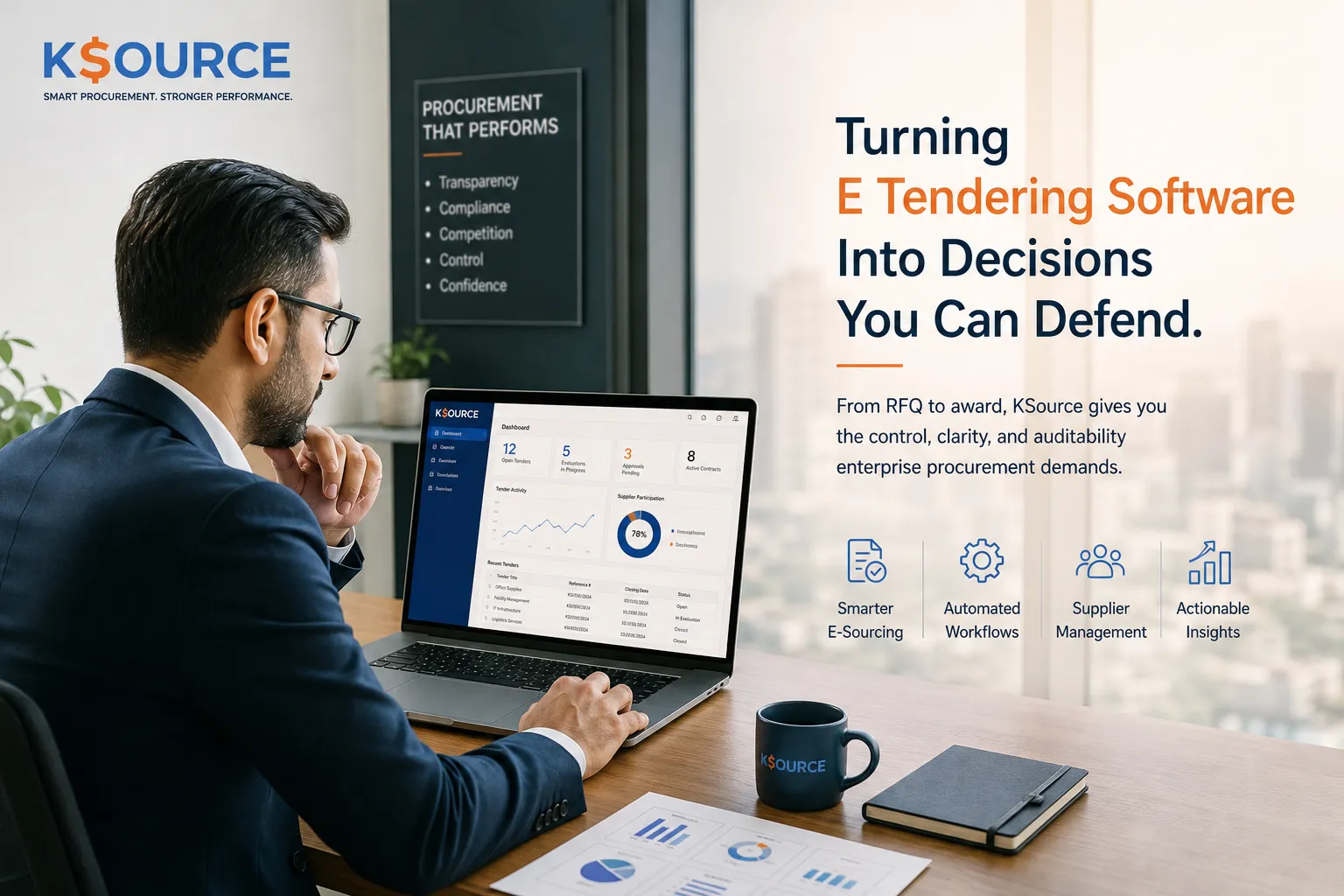
What e tendering software means in practice
E tendering software is not just a portal for uploading bids; for an enterprise procurement director, it is the controlled workspace where a tender is created, suppliers are invited, bids are received under defined rules, evaluations are recorded, and the final award can be explained to finance, audit, management, and vendors. In Pakistan, where medium and large organisations often manage high-value purchases across multiple departments, the real test is whether the system helps you make a sourcing decision that is fair, traceable, and defensible.
That is why the useful question is not “Can this software collect quotations?” Most tools can do that. The better question is: “Can this platform preserve the integrity of the tender from requirement to purchase order?” A procurement team may need to source raw materials, professional services, logistics support, plant maintenance, IT equipment, or contract labour. Each category has different evaluation logic, but the evidence trail should be consistent: who requested the tender, which suppliers were invited, what changed in the specification, when bids closed, how sealed bids were opened, and why the winning vendor was selected.
The best tender management system is the one that protects the decision
The best tender management system for an enterprise buyer is not necessarily the longest feature list. It is the system that fits the way your organisation actually buys while tightening weak points in the process. For a CFO, that may mean spend visibility and an audit trail. For a procurement director, it may mean sealed bidding, controlled supplier communication, and consistent evaluation. For a supply chain director, it may mean faster cycle times without losing compliance.
A defensible system should support several practical controls:
Structured tender setup: the team should be able to define scope, items, quantities, documents, deadlines, terms, evaluation fields, and approval flow before inviting vendors.
Supplier access with clarity: vendors should know what they are bidding on, what documents are required, and when submissions close.
Sealed submission handling: bid visibility should follow the rules of the tender, not the convenience of the buyer or vendor.
Workflow continuity: the tender should not die after award; it should connect sensibly into purchase order workflows where relevant.
For example, if a manufacturing company in Karachi invites suppliers for a maintenance contract, email-based bidding can quickly become difficult to defend. One supplier sends a revised attachment after the deadline, another asks for clarification on WhatsApp, and the evaluation sheet sits on one person’s laptop. Even if the final award is commercially sound, the process looks fragile. E tendering software should reduce that fragility by keeping activity inside an accountable workflow.
KSOURCE’s For Enterprise Buyers page is the relevant starting point for organisations that want to understand how the platform is positioned for buyer-side procurement workflows rather than only vendor registration or bid collection.
What is a tender, and why does the definition matter?
A tender is a formal request for suppliers to submit an offer against defined requirements. In procurement practice, that definition matters because a tender is not the same as a casual quotation request. It has rules: what is being purchased, who may participate, how responses must be submitted, what the deadline is, how bids will be evaluated, and what conditions apply after award.
In enterprise buying, the word “tender” usually signals a need for fairness and documentation. A purchase of routine office supplies may only need a simple RFQ.
The distinction also matters for suppliers. Vendors participating in digital procurement need confidence that the buyer is running a clear process. If tender documents are incomplete, deadlines change informally, or submission rules are unclear, strong suppliers may either price in risk or avoid participating. A good tender process improves competition because vendors understand the rules before they invest time preparing a bid.
Why a tender management system becomes necessary
A tender management system becomes necessary when the value, risk, frequency, or visibility of procurement exceeds what email and spreadsheets can safely handle. The breaking point is usually not one dramatic failure. It is the steady accumulation of small process weaknesses: missing attachments, unclear approvals, late bid changes, duplicate vendor records, inconsistent evaluation notes, and award decisions that require too much manual explanation.
For procurement leaders in Pakistan, this is especially relevant where purchasing may involve multiple branches, plants, business units, or approval layers. A central procurement team may be asked to move faster, save cost, onboard new suppliers, satisfy internal controls, and keep vendors engaged. Without a system, the team often compensates with more meetings and more manual tracking. That may work for a few tenders, but it does not scale well.
The value of e tendering software is strongest in four areas:
Transparency: the organisation can see tender status, supplier participation, and decision history.
Consistency: recurring categories can follow repeatable workflows instead of being rebuilt from scratch.
Control: deadlines, sealed bidding rules, and approvals are less dependent on personal follow-up.
Vendor experience: suppliers receive a clearer route to participate, submit, and respond to buyer requirements.
The mistake to avoid is treating tender software as a document cabinet. If the system is only used to upload files after decisions are already made elsewhere, it will not improve governance. The process has to live in the platform: tender creation, vendor invitation, bid receipt, evaluation, award, and downstream procurement action.
Tender creation: build the decision before you invite bids
Tender creation is where many procurement problems either get prevented or quietly introduced. A well-created tender gives suppliers enough structure to compete on the same basis.
Before publishing a tender, the buyer should define the requirement in operational terms. What is being purchased? Is the quantity fixed or estimated? Are delivery locations specified? Will the award be based only on price, or on technical compliance plus commercial value? These details matter because the software can only enforce rules that procurement has properly defined.
In a strong e-procurement workflow, tender creation should include:
Clear item or service lines: suppliers should not have to guess how to price the requirement.
Required documents: tax registration, company profile, technical documents, compliance certificates, or other buyer-required files should be requested explicitly where relevant.
Submission deadline and bid rules: including whether bids are sealed and when they can be opened.
Approval routing: internal reviewers should be defined before the tender goes live, especially for high-value purchases.
Evaluation method: the team should know in advance whether it is comparing lowest compliant bid, weighted technical and commercial scoring, negotiated outcome, or another approved method.
KSOURCE’s RFQ and sealed bidding context is relevant here because many enterprise tenders begin as structured RFQs but require stronger controls as the value or risk increases. If your immediate challenge is the RFQ layer, the related KSOURCE article on RFQ process automation explores that operating problem in more depth.
Vendor creation: supplier data is part of tender integrity
Vendor creation is often treated as an administrative step, but it directly affects tender quality. If supplier records are duplicated, incomplete, outdated, or not approved, the buyer can end up inviting the wrong vendor, missing qualified suppliers, or struggling to justify the supplier pool after the tender closes.
In practical terms, vendor creation should answer three questions before a supplier enters a tender: who is the supplier, what categories can they serve, and are they approved to participate? For enterprise buyers, that may include business details, contact information, category mapping, tax or registration documents, compliance status, and internal approval. The exact data requirements vary by organisation and category, but the principle is stable: supplier records should support procurement decisions, not merely store names.
For vendors, good onboarding reduces uncertainty. They know what information the buyer needs, where to submit it, and how to participate once approved. For buyers, it reduces the risk of informal supplier lists living outside the procurement platform. KSOURCE has a separate guide on the supplier onboarding process for teams that need to tighten verification and approval before suppliers join sourcing events.
A common mistake is opening tenders to suppliers before vendor records are clean. That may look faster at the start, but it creates problems later: evaluation teams cannot compare vendor eligibility, finance may not have the correct supplier information for PO processing, and audit questions become harder to answer. Vendor creation is not separate from tender management; it is one of its foundations.
Where e tendering software can still go wrong
Software improves control, but it does not automatically fix weak procurement design. A platform cannot make an unclear specification fair, cannot choose evaluation criteria for a business without procurement judgment, and cannot compensate for supplier data that was never verified. These are not reasons to avoid e tendering; they are reasons to implement it carefully.
Three practical risks deserve attention. First, overcomplicated workflows can slow adoption. If every low-value purchase requires the same approval depth as a strategic tender, users may try to work around the system. Second, poor tender templates can standardise confusion. Reusing a bad template simply spreads the problem faster. Third, weak change control can damage trust. If requirements, deadlines, or evaluation rules change during a tender, the platform should help record and communicate those changes clearly.
Data handling also matters. Procurement systems hold supplier information, commercial submissions, and internal decision records. Buyers should review privacy and data practices as part of vendor due diligence. KSOURCE provides its Privacy Policy for organisations that want to review how privacy is presented before engaging further.
What is tender management software?
Tender management software is a system used to create tenders, invite suppliers, receive bids, manage clarifications, support evaluation, and record award decisions. In enterprise procurement, its value is strongest when it connects tender activity with supplier management and downstream purchasing workflows.
How should a procurement director get started?
Start by mapping two or three current tender types that cause the most friction: for example, recurring RFQs, high-value sealed bids, or vendor-heavy service contracts. Identify where control breaks down today, then assess whether the software can handle those points inside the workflow rather than outside it in email.
Is e tendering only for large public-sector procurement?
No. Public procurement is a common association, but private-sector enterprises also use e tendering when purchases require competition, documentation, supplier fairness, and management approval. The need is driven by procurement risk and process complexity, not only by sector.
What mistakes should buyers avoid?
Do not digitise an unclear process without improving it. Clean up supplier records, define tender templates, agree evaluation rules, and decide approval levels before rollout. Otherwise the software may capture the same confusion more neatly without improving the quality of decisions.
Your next move with KSOURCE
If you are evaluating e tendering software, begin with one defensible decision path: requirement creation, vendor selection, sealed bid receipt, evaluation, award, and purchase order handoff. Then ask whether the platform supports that path clearly enough for procurement, finance, suppliers, and leadership to understand after the fact.
